
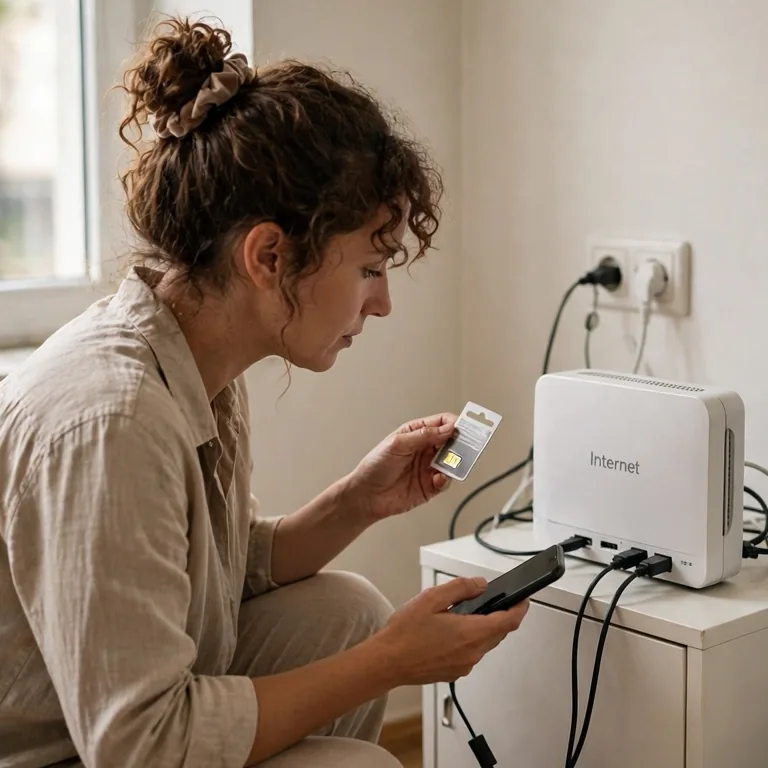
Check activation for mobile and availability of home internet
When you need mobile service during the time you are comparing subscriptions, a prepaid SIM (mobile network card) may be an option. Before you pay, look at the activation rules and whether your phone is compatible. For home internet, find out which providers cover your exact address. Compare the total cost and the contract length, and then confirm the activation date and any installation appointment.
This guide deals with personal contracts for mobile and home internet for newcomers who live in the Netherlands.
Decide how to pay for mobile service
There are three options: buy prepaid credit, choose sim-only (a subscription that does not include a phone), or take a subscription with a phone. Prepaid means calls and data are paid for in advance. With sim-only, you use a phone that you already have. If you pay for a new phone in instalments, you borrow whatever amount remains after any upfront payment.
In 2026, device loans over €250 are registered with BKR (Bureau Kredietregistratie, the Dutch credit register). If you already have a phone, compare prepaid and sim-only before you borrow money for a new one.
Wide tables can be scrolled sideways.
| Option | Check before ordering | How you pay |
|---|---|---|
| Prepaid | Activation, identity checks, rates and credit expiry | Buy credit in advance |
| Sim-only | Coverage, data, total cost, contract length and payment method | Pay for service; you provide the phone |
| Phone with subscription | Service costs and device-loan terms | Pay for service and repay the phone loan |
Prepaid may be useful while you compare subscriptions or wait for documents. Check who the seller is and what the activation rules are. Before you pay, check if the SIM works in your phone, how to top up credit, when the credit expires, and whether digital SIM activation is offered.
Look at toestelkrediet (device credit)
If you pay for a phone in instalments, the provider has to check that you can afford the monthly costs. The provider must explain the terms of the loan and the interest. It must also list the phone costs separately from the service costs. Rijksoverheid (Dutch central government) explains how an upfront payment can bring the loan below €250. If the amount is exactly €250, check the provider’s credit terms: Odido’s terms require registration.
Example for 2026: a phone costs €600. You pay €400 upfront and borrow the remaining €200. That loan is under the €250 registration threshold. You still pay the mobile service charges and repay the €200.
BKR registers device loans above the threshold even if you pay on time. When you apply for another loan, including a mortgage, lenders can take that loan into account.
The phone loan and the mobile service are separate agreements. If you end or change your service, the remaining phone balance does not always become due right away. Before you cancel or change your service, read the loan’s own terms to find out whether repayments continue or you have to pay the balance. Ask for a written repayment schedule that shows the remaining balance and the payment dates.
Check mobile coverage and the features of your phone
Check coverage in the places where you will use your phone, including your normal routes and indoors at home and at work. Reception can be affected by building materials and by where you are indoors. Brands that use the same network may offer different speeds and features. Check whether the plan includes 5G (fifth-generation mobile network) access, what calling features it has, and any limits on data use or speed. If you can, test reception before you take a long contract. ACM ConsuWijzer (consumer advice from Autoriteit Consument & Markt, the Dutch Authority for Consumers and Markets) explains what to compare.
Rijksinspectie Digitale Infrastructuur (RDI, Dutch Authority for Digital Infrastructure) lists three mobile networks in the Netherlands: KPN, Odido and VodafoneZiggo. Other brands may be MVNOs (mobile virtual network operators) that use one of those networks. The ACM Telecom Monitor for the fourth quarter of 2025 lists the operators and their market shares.
An eSIM (digital SIM) is installed in a phone that is compatible. Check if your provider and your phone support it. Check how to activate it and how to transfer your number. If you want to keep a foreign SIM active alongside a Dutch line, check dual-SIM (two-line) support and whether the phone is unlocked for other providers. For an iPhone, Apple’s dual-SIM guide explains which models are compatible and what provider requirements apply.
Check the documents and the payment method
For every product and every way of ordering, such as a website, a shop or a phone order, providers set identity and fraud checks. Ask the provider about all three checks:
- Identity: which passport, identity card or residence document is accepted by the website, the shop or the courier?
- Payment: which payment methods and IBANs (international bank account numbers) are you allowed to use?
- Credit: if you pay for a phone in instalments, which affordability and credit checks apply?
If a company offers euro transfers or direct debits, it must accept an eligible payment-account IBAN from the EU (European Union) or EEA (European Economic Area). For these payments, a Dutch IBAN is not required. If the company’s online form accepts only Dutch IBANs, it can provide another way to enter a foreign IBAN. The company must explain that option clearly on the form.
If a company refuses your IBAN because of the country code, see The provider asks for a Dutch IBAN. For more information about account requirements, see Opening a Dutch bank account.
Keep your number and check the costs of roaming
Nummerbehoud (keeping your phone number) costs nothing. Ask your new provider to transfer your Dutch mobile number. Your old provider is not allowed to refuse the transfer or charge for it. Prepaid numbers also qualify. You can ask for a transfer up to one month after the old contract ends. Apply early enough so the providers can process it. The ACM ConsuWijzer number-transfer guide explains the procedure.
If you transfer your number before the fixed term ends, you may still have to pay charges under the old contract. A fixed telephone number can be kept only if you stay in the same area-code region.
Roam like at home (using your domestic mobile plan abroad) applies in the EU, Iceland, Liechtenstein, Norway, Moldova and Ukraine. The data allowance you get while roaming may be smaller than your domestic allowance. If you go over that allowance, or if you use the SIM mainly abroad, capped extra charges can apply. Check your plan’s conditions in Your Europe’s roaming guide.
Satellite networks on ships or aircraft are outside these roaming rules and may cost more. To avoid connecting to them, turn off roaming or use flight mode.
Check home internet for your exact address
Home internet can be delivered through glasvezel (fibre), kabel (cable) or DSL (internet over a copper telephone line). Which connections and providers are available depends on your address. On provider websites or comparison sites, enter your postcode and house number. The ACM ConsuWijzer fixed-internet guide explains why the options differ.
When you compare offers, use the same details: the speed your household needs, the price after discounts, one-off charges and the total cost over the fixed term. Also compare the contract length, equipment, delivery, activation date, and any technician fee or appointment. Before you pay for a faster plan, choose a speed that meets your household’s needs.
Confirm when the connection will be working
After you know your address, ask the provider to confirm the modem delivery, the line activation and any installation appointment. Check if you can install the modem yourself. Keep a mobile backup until the home connection is working.
Order and switch using confirmed dates
For a home internet order, follow these steps:
- Check which connections and providers are available for your postcode and house number.
- Compare the full cost of the contract and the installation requirements.
- Ask the provider you choose to confirm the activation date.
- If you are switching, confirm who will cancel the old contract and the date when this will happen.
- Keep the order confirmation.
- Connect the modem, or go to the installation appointment you agreed.
Installation depends on the provider and the address. The provider may need to activate the line or send a monteur (technician). Ask what happens if the promised start date is not met.
For an online or phone order, bedenktijd (cooling-off period) allows you to cancel without giving a reason. If the order is for service alone, the period ends 14 days after the day you agree to the contract. If the order combines a phone and service, it ends 14 days after the day you receive the phone. A normal shop purchase has no statutory cooling-off period. The ACM ConsuWijzer cooling-off guide explains the rules.
If you agreed in advance to early activation and to paying for the service you used, you pay for that part when you cancel. If there was no permission to start early, you can claim a full refund. When the deadline falls on a weekend or public holiday, it moves to the next working day.
When you switch home internet, check if the provider offers overstapservice (a switching service). Confirm who will cancel the old contract. If the new provider promised to cancel it but did not, cancel the old service as soon as you discover this. Keep both confirmations. You still owe the old provider’s bill, but the new provider must reimburse the extra costs that its failure caused. The ACM ConsuWijzer switching-problems guide explains the remedy.
Check when you are allowed to cancel your contract
Once the fixed term is over, you can cancel at no cost with no more than one month’s notice. Before you accept, read the contract summary. The ACM ConsuWijzer cancellation guide explains these rules on term and notice in 2026.
Wide tables can be scrolled sideways.
| Rule | What it means |
|---|---|
| Maximum fixed term | At most 2 years; the provider needs a good reason for a 2-year term, such as a discount |
| After the fixed term | Cancel free at any time with at most 1 month’s notice, starting on the day you cancel |
| End-of-term notice | The provider must contact you at least 1 month before the fixed term ends |
| Disadvantageous change | Usually cancel free within 1 month after notification; exceptions apply below |
If a price or terms change is disadvantageous to you, the provider must normally tell you one month in advance. You can usually cancel without extra costs within one month after the notification. If one service in a bundle changes to your disadvantage, you can cancel the entire bundle. The ACM ConsuWijzer terms-change guide explains the right and these two exceptions:
- If a change is required by a new law or government rule, it does not give a free cancellation right for that reason.
- An inflation adjustment does not give a free cancellation right if the terms clearly explain the adjustment, including how often it happens and when it happens.
If you cancel during a fixed term, charges stated in the contract may apply. Ask for a written calculation with separate amounts for the service, the unpaid phone balance and the return of equipment. Check the phone-loan agreement separately: repayments may continue, or you may have to pay the remaining balance. Ask when each amount is due.
Solve problems with contracts and connections in writing
Ask the provider to put an explanation of the problem and the proposed solution in writing. Keep the order, contract, bills and messages so that you can support a complaint.
The provider asks for a Dutch IBAN
Ask if you can enter an EU or EEA euro payment-account IBAN by hand, or if you can order through another route. If the company refuses it because of the country code, make a written complaint and keep the refusal and your complaint. If the company offers no suitable solution or does not reply, report it to De Nederlandsche Bank (DNB, the Dutch central bank).
The provider rejects your documents
Ask which requirement applies to your product and to the way you are ordering. For example, Odido’s ordering page says that a foreign passport or a non-Dutch European identity card allows sim-only, but not a subscription with a phone.
In October 2026, Odido accepts a foreign payment-account IBAN only in its shops and only for sim-only. For that order, it requires all three documents listed below:
- Your foreign bank card.
- A valid identity document.
- A BRP-uittreksel (extract from the municipal Personal Records Database).
The extract must be no more than one week old and must show at least six months of registration in the Netherlands.
If your registration date is missing from the extract, Odido asks for an extra statement from your gemeente (municipality). You pay for the extract yourself. Odido rejects extracts for non-residents. These are Odido’s requirements. If you cannot meet them, compare another way of ordering, prepaid or another provider. The BSN (citizen service number) and municipal registration guide explains the wider registration process.
No active home connection exists at your address
For a temporary connection, you can use a 4G (fourth-generation mobile network) or 5G router. Before placing it indoors, check the coverage at that spot. Compare these points: data allowance and fair-use limits (the provider’s rules on data use), total cost, fixed term, equipment return, and delivery. Make sure the home internet order stays separate. Cancel the temporary service according to its own terms.
You are moving within the Netherlands
Before you arrange the move, look at the provider’s verhuisregeling (moving policy). Whether the contract moves with you, stops, or results in charges depends on your provider’s terms and whether service is available at the new address. Ask for the activation date, any overlap, costs, and equipment instructions in writing. If you move during a fixed term, you may still have to pay for the months that remain.
You are moving out of the Netherlands
Before you leave, ask your provider if its moving policy applies to emigration. Ask for the contract end date and an itemised calculation of charges. Review the phone-loan terms: will repayments keep going, or do you have to pay off the remaining balance? Obtain the payment dates in writing. If the calculation does not match your contract, file a written complaint with the provider.
Should the complaint stay unresolved, De Geschillencommissie Telecommunicatiediensten (Telecommunications Services Disputes Committee) might be able to assist when your provider takes part. You can also tell ACM ConsuWijzer about consumer-law concerns.
For other things to do after you arrive or move, consult these guides:
- Utilities in the Netherlands
- Cost of living in the Netherlands
- First 90 days in the Netherlands: arrival checklist
Official Sources
- Rijksoverheid: Is een telefoonabonnement waar een mobiele telefoon bij zit een lening? - Phone instalments as a loan, affordability checks, separate phone and service costs, and reducing the loan with an upfront payment.
- BKR: Telefoonabonnement - Device-loan registration above €250 and repayment alongside mobile service charges.
- ACM ConsuWijzer: Tips bij het kiezen van een abonnement voor mobiele telefonie - comparing mobile coverage, speed, term, fees, roaming and switching
- ACM ConsuWijzer: Een telecomaanbieder kiezen voor vast internet en bellen - address-dependent cable, copper and fiber options and postcode checks
- ACM ConsuWijzer: Telecomabonnement opzeggen - maximum term, end-of-term notice, cancellation and provider moving policies
- ACM ConsuWijzer: Telecomaanbieder wijzigt voorwaarden - free cancellation after disadvantageous changes and the legal exceptions
- ACM ConsuWijzer: Bedenktijd - the start date of the 14-day period for services and product-service bundles
- ACM ConsuWijzer: Telefoonnummer meenemen - free number porting, including the one-month deadline after a contract ends
- ACM ConsuWijzer: Problemen bij overstappen telecom - switching-service interruptions and reimbursement of avoidable double costs
- ACM: Telecommonitor vierde kwartaal 2025 (telecom market report for the fourth quarter of 2025) - Market shares of the named mobile operators and mobile virtual network operators, and fixed-network connection types.
- De Nederlandsche Bank: SEPA (Single Euro Payments Area) en IBAN-discriminatie - the ban on rejecting an EU/EEA euro IBAN and the DNB complaint route
- Odido: Je bestelling van Mobiel - Odido-specific product restrictions for foreign identity documents and shop-only foreign-IBAN orders, including the one-week BRP extract and six-month registration requirements.
- Your Europe: Roaming — using a mobile phone in the EU - EU/EEA, Moldova and Ukraine roaming, fair use and satellite-network exclusions
- De Geschillencommissie: Telecommunicatiediensten - Consumer telecom disputes with participating providers after a complaint to the provider.
- RDI: Dekkings- en snelheidsverplichting - The three mobile networks and why coverage and performance vary indoors, by device and by subscription.
- Apple: Using Dual SIM with an eSIM - Digital SIMs, compatible iPhones and providers, and the unlocked-phone requirement when using two providers.
- Rabión Consultancy for Ministerie van Economische Zaken (Ministry of Economic Affairs): mobile network code study, October 2025 - Section 2.6 explains that mobile virtual network operators use a public mobile network rather than their own radio network.
- Rijksoverheid: Citizen service number (BSN) - The English gloss of BSN and its link to registration in the Personal Records Database.
- KPN: Installation by a technician - A provider example of self-installation, technician appointments and installing a modem for a new connection or move.
- Odido: Home internet through the mobile network - A provider example of home internet through a mobile router, local reception checks and temporary use during a move.
- Odido: Mobile-router connection details - A provider example of a mobile home router using 5G and usually falling back to 4G when 5G is temporarily unavailable.
- Autoriteit Financiële Markten (AFM, Dutch Authority for the Financial Markets): Telefoonkrediet - Phone-credit agreements are agreed separately from mobile service agreements, with separate costs.
- Odido: Only a phone payment remains - Exceptional cases where monthly phone repayments continue after the mobile service ends.
- Odido: Device-credit terms from 7 November 2025 - Separate loan and service agreements, repayment schedules, BKR registration at €250 or more, and conditions that can make the remaining balance due immediately, including emigration.
- Odido: Additional mobile home-internet terms - A provider example of rules on personal data use, network load and network priority.