
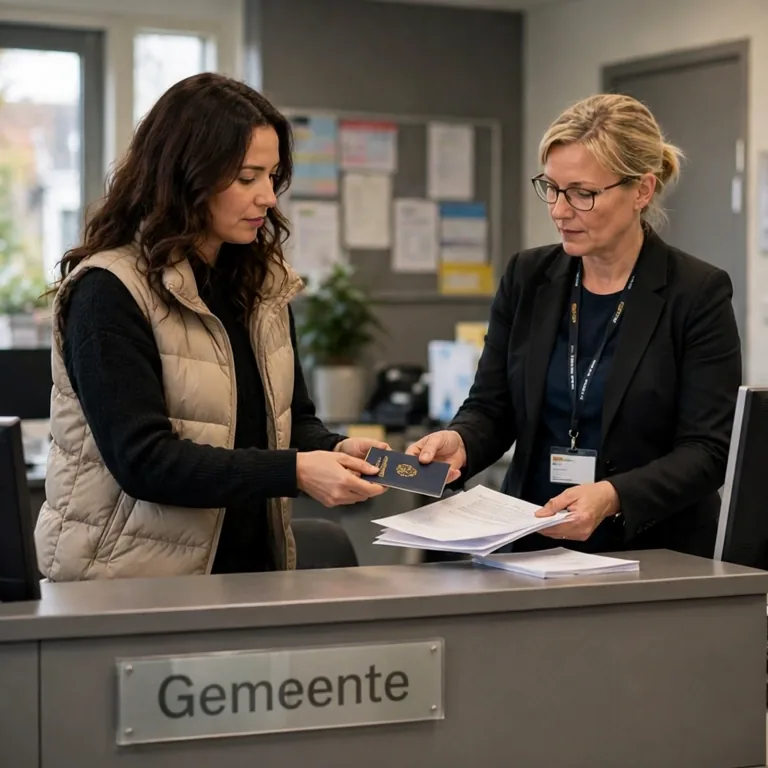
When you register, you receive a BSN automatically.
When you register, you receive a BSN automatically. To register as a resident, you must have the right to live here and expect to stay at least 4 months within a 6-month period. On the standard route, you register with your gemeente (municipality) no later than 5 days after you arrive. If you need a BSN for a shorter stay, an RNI (non-resident register) desk is available. In 2026, neither route costs anything.
This guide is meant for people who are arriving in the Netherlands, among them partners and children, as well as people who need a BSN for a short stay.
Why do you need a BSN?
Your BSN is used by government organisations to process and exchange your personal data. It also appears in records kept by healthcare providers, health insurers, schools and the tax authorities. To apply for DigiD (digital identity), the secure login for Dutch government services, you need a BSN.
To receive government post digitally, use MijnOverheid (government account) and Berichtenbox (message box). Then follow the MijnOverheid and Berichtenbox setup guide.
Check who must integrate in the Netherlands if you do not know whether inburgering (civic integration) applies to you.
Registering in the BRP (personal records database): how does it work?
To register as a resident, you need the right to live in the Netherlands and an expected stay of at least 4 months within a 6-month period. You register with the gemeente where you live. This rule is set by the Wet basisregistratie personen.
Different registration rules may apply if you have diplomatic status, if you are a NAVO (NATO, the North Atlantic Treaty Organization) staff member or family member, or if you live in an asylum reception centre. Ask your gemeente which registration route is for you.
If you do not have valid residence status and your required residence permit is still pending, you may postpone registration. If the gemeente must investigate your identity, you may wait until it makes a decision. Ask your gemeente which rule applies in your case. These exceptions to the 5-day deadline are listed in the Rijksoverheid (Dutch central government) registration guidance.
When your health or detention stops you from attending, another person may be able to register on your behalf. Ask the gemeente who is allowed to do this and what evidence it requires. The rules are explained in RvIG (National Office for Identity Data).
For a child younger than 16, a parent, guardian or carer declares residence. The same person also declares for a 16- or 17-year-old living with them, unless the teenager declares residence personally. The gemeente may ask a represented child to come in order to confirm identity. If you declare your own residence, you must attend in person unless a legal exception to attendance applies. Ask the gemeente which family members must attend. Every person needs a valid identity document.
Waiting times at the gemeente can be long. Get in touch with yours well before you travel. Check what each family member must bring. Take these steps in order:
- Make a registration appointment with your gemeente.
- Collect the documents listed on your gemeente’s checklist.
- Go in person within 5 days after arrival.
Your details are entered into the BRP by the gemeente. If you already have a BSN, you keep that BSN. If a new BSN is needed, it can take a few weeks to receive it. How long this takes depends on your gemeente.
For instance, if you move from abroad for a 6-month stay, you use resident registration. If you make a 2-month work visit and need a BSN, you use the RNI route.
If you are 14 or older and have temporary protection for Ukraine, pick up your residence proof from the IND within four weeks after you register with the municipality. Make an appointment. On the day of the appointment, you must have been registered for at least one week.
After assessment, a specialised BRP registration-centre appointment is given automatically to eligible asylum seekers staying longer than six months, to asylum permit holders, and to people who arrive through asylum family reunification. Wait for that appointment. Do not arrange it yourself with the centre, the IND or the national coordination point.
What should you bring?
Because requirements differ, use the checklist from your own gemeente. The documents below are listed in the national moving checklist. Bring proof of identity and address, along with any other documents your situation requires:
- A valid form of identity document.
- Evidence that you live at the address: a rental contract, a purchase contract or written permission from the main occupant.
- Your residence document, if your gemeente asks for it in your situation.
- If the gemeente requests them, documents about your family situation, for example birth, marriage or divorce certificates.
- Proof of deregistration if you arrive from Aruba, Curaçao, St Maarten, Bonaire, St Eustatius or Saba. If you come from another country, the gemeente may also ask for this.
The national checklist names a passport, driving licence, Dutch identity card or alien’s identity card as examples. Ask your gemeente which document it accepts for your registration.
Preparing foreign documents: what should you do?
Before the gemeente can use foreign documents, they may need legalisatie (official checks of signatures and stamps). Arrange any required legalisation in the country that issued the document. Check the official rules for your document’s country before you travel.
When a document is in a language other than Dutch, English, French or German, use a sworn translator to translate it. A translation produced in the Netherlands does not need legalisation. A translation produced abroad may also need legalisation; check the rules for that country.
An apostille (official signature stamp) is a sticker or stamp that verifies the signature on a document. If the Netherlands accepts an apostille, it replaces any further legalisation. The Netherlands does not accept apostilles from Bangladesh or Pakistan; for the alternative legalisation route, check the official apostille country list. Many documents from another EU (European Union) country do not need an apostille. Check what is required for your country and document.
If you satisfy the other registration conditions but cannot provide required foreign certificates within a few days, the municipality must register you based on the strongest evidence available. Agree on when you will supply the missing documents. Certain family details may stay unrecorded until suitable evidence is available.
How do you register for a stay of less than 4 months?
If you need a BSN for a stay of less than 4 months, for example a short work or study visit, you can register in the RNI. If you live abroad, you can also use this route for matters involving the Dutch government. Registering in the RNI is optional. It is free in 2026.
Which desk you can use depends on your nationality. In 2026, choose one of these options:
- If you have Dutch, other EU, Norwegian, Icelandic, Liechtenstein or Swiss nationality: any of the 19 RNI desks.
- If you have another nationality: only the RNI desks in Breda or Venlo.
If you are registering a child younger than 16, you must also bring that child’s valid passport or EU identity card, plus either a birth certificate or a declaration of acknowledgement of parentage that shows you are the child’s parent. Find out if documents from another country require translation or legalisation.
A valid passport or identity card is required. If you do not speak Dutch or English, arrange for an interpreter to come with you. After selecting a desk where you are eligible, carry out the following steps:
- Schedule an appointment at the RNI desk you chose.
- Collect all documents that are required.
- Go to the appointment in person, together with every person you are registering, children included.
At the RNI desk, you will be given a letter containing your BSN. Should your plans change and you anticipate remaining in the Netherlands for at least 4 months within a 6-month period, you must register as a resident with your local gemeente. Your BSN stays the same.
How can common registration problems be dealt with?
When you do not have an appointment, an address, or your BSN, get in touch with your gemeente. The following sections describe what you should request.
What should you do when no appointment can be booked within 5 days?
Registering after the deadline remains possible. A late registration may lead the gemeente to fine you. If waiting times make it impossible to register within 5 days, reserve the first appointment that is available and retain the confirmation. During that appointment, ask if the gemeente can register you as of the date on which you booked. This advice comes from the national moving checklist; it does not promise that your registration will be backdated. If you need assistance with booking, contact the gemeente directly.
What can you do if you have no home address?
When you do not have a home address, ask your gemeente about a briefadres (correspondence address). People who live in an institution can also use this route. The gemeente assesses whether you meet the requirements. A briefadres is an administrative address used for government mail.
A briefadres can be provided by someone who is registered at a home address, at an approved institution, or with the gemeente. If you are eligible but unable to find a provider, the gemeente is required to register you at a briefadres, such as at the town hall. That address has to be located in the Netherlands and may not be a postbus (post office box).
If the address is being provided by someone you know, submit your application at Burgerzaken or Publiekszaken (population affairs department) in the gemeente where that address is located. Take all of the following documents with you:
- A valid identity document belonging to you.
- Written consent signed by the provider.
- The provider’s valid identity document, or a copy of it.
- A written explanation, as set out in the Government.nl checklist, of why you need a briefadres.
A briefadres has no maximum duration. You may keep it for as long as you satisfy the conditions. Ask the gemeente what additional evidence it requires and when it will review your circumstances.
What should you do if your landlord or host refuses to allow registration?
When you have a home address but your landlord or host will not allow registration, inform the gemeente of the place where you truly live. Describe the refusal and bring proof of your address. Ask if an adresonderzoek (address investigation) is necessary. Registration is based on where you live, not on whether the landlord agrees. For assistance with this route, use the address-registration problems guide.
What should you do if your BSN has not yet arrived?
After resident registration, a new BSN may take several weeks to reach you. How long it takes varies by gemeente. Because the number is assigned automatically, you can inquire about its status without submitting another application. Ask how you will receive it. If the delivery date the gemeente gave you has already passed, contact the gemeente.
For other matters after you arrive, select the guide that fits your needs:
- First 90 days in the Netherlands: arrival checklist — for DigiD, health insurance, banking, and other tasks related to arrival.
- Finding and using a huisarts (general practitioner) in the Netherlands — for signing up with a doctor.
Official Sources
- NetherlandsWorldwide: When do I have to register with a Dutch municipality? - resident registration, the 5-day in-person deadline, family attendance and keeping an existing BSN
- NetherlandsWorldwide: What is a citizen service number (BSN)? - what the BSN is (an 8- or 9-digit number issued on BRP or RNI registration) and what you need it for
- Government.nl: Citizen service number (BSN) - everyone registered in the BRP is automatically given a BSN, and what it is used for across government, healthcare and benefits
- NetherlandsWorldwide: Checklist for moving to the Netherlands - registration documents, foreign-document preparation, booking before travel, appointment delays and municipal BSN delivery times
- Government.nl: Can I register in the BRP if I have a correspondence address? - the private-provider application route and documents; read with the Dutch guidance below for institutional and municipal providers
- DigiD: identify yourself online - DigiD identifies you when you use services online; the application page below confirms the BSN requirement
- Wetten.overheid.nl (Dutch legislation database): Wet basisregistratie personen - Articles 2.4 and 2.38: lawful stay, at least 4 months in a 6-month period, the 5-day declaration deadline and late registration; article 2.23: municipal correspondence addresses
- Rijksoverheid: Registering as a resident in the BRP - free resident registration, family attendance and exceptions while residence status or identity is unresolved
- RvIG: Registratie van Niet-Ingezetenen (non-resident registration) - optional non-resident registration for people abroad and short stays; the January 2026 restriction to Breda and Venlo for people without a European passport
- NetherlandsWorldwide: Registering in the RNI - the exact nationality groups for RNI desks, free registration, personal attendance, identity and child documents, interpreters and the BSN letter at the desk
- Rijksoverheid: Registering on a briefadres - eligibility, private and institutional providers, required documents and the duty to provide a municipal address when an eligible person cannot find a provider
- NederlandWereldwijd (NetherlandsWorldwide, Dutch government information service): When an apostille is needed - apostille requirements depend on the country and document; many EU documents need no legalisation
- NederlandWereldwijd: Countries where an apostille is valid - the Netherlands does not accept apostilles from Bangladesh or Pakistan
- NederlandWereldwijd: Where to obtain an apostille - a foreign-document apostille must come from the issuing country; sworn translations and the exception for translations made in the Netherlands
- NederlandWereldwijd: Legalising foreign documents - the official country-by-country procedures for preparing foreign documents for use in the Netherlands
- Officiële bekendmakingen (official publications): BRP address registration, parliamentary answers - registration follows actual residence, rather than landlord or occupant consent; municipalities investigate doubtful address information
- DigiD: Apply for a DigiD - a BSN is required to apply for DigiD
- RvIG: Resident registration and attendance exceptions - personal attendance, under-16 child representation and health or detention exceptions; special registration rules for privileged persons, NAVO staff and families, and some reception-centre residents
- MijnOverheid: Digital government post - the Berichtenbox receives digital government post through MijnOverheid
- NederlandWereldwijd: What is legalisation? - legalisation verifies the official issuer, signatures, stamps and document form
- RvIG: Maximum duration of a briefadres - there is no maximum duration for a briefadres; registration can continue while the eligibility conditions are met
- NATO: North Atlantic Treaty Organization - the organisation’s official English name and acronym
- IND: Temporary Protection Directive Ukraine - If you have temporary protection for Ukraine and are 14 or older, collect your residence proof from the IND within four weeks after municipal registration. Book an appointment. You must have been registered for at least one week on the appointment day.
- IND: Registration at a BRP registration centre - Eligible asylum seekers staying over six months, asylum permit holders and people arriving through asylum family reunification receive a specialised BRP registration-centre appointment automatically after assessment. Wait for that appointment; do not arrange it yourself with the centre, IND or national coordination point.
- RvIG: Akten en Brondocumenten - If you meet the other registration conditions and cannot supply required foreign certificates within a few days, the municipality must register you using the strongest available evidence. Agree when to supply missing documents. Some family details may remain unrecorded until suitable evidence is available.