
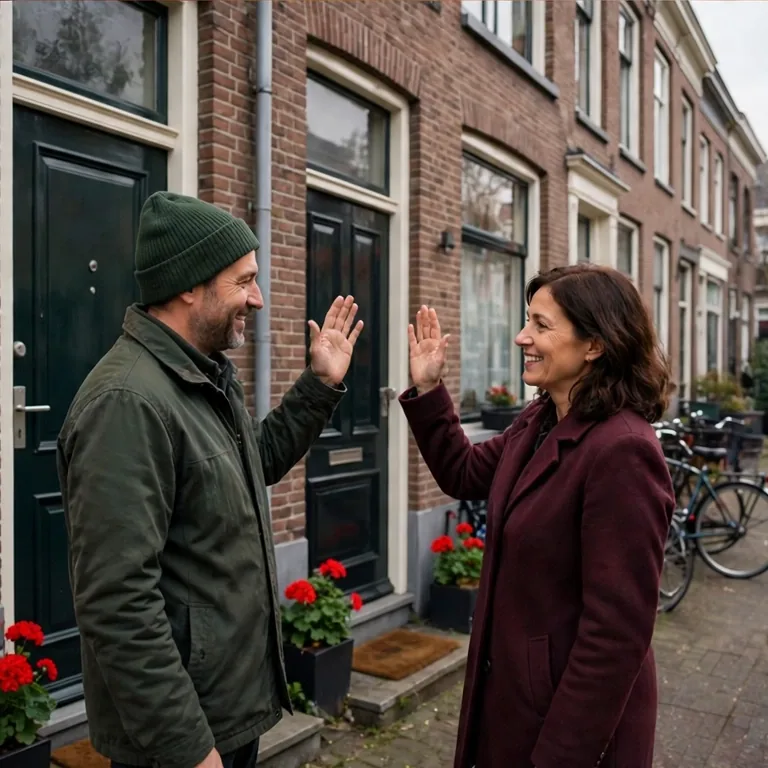
Find out what is expected in each situation
If you are new to the Netherlands, settle the time of a visit and ask how any shared costs will be divided. Let the host guide you on greetings. State your own preference. Families, social groups, regions, generations and workplaces all have different customs. If a visit, birthday treat or work event leaves you unsure, ask the host, teacher or colleague what they expect.
Customs can vary according to your social group, region, generation, and social or economic background. The official KNM (Kennis van de Nederlandse Maatschappij, knowledge of Dutch society) learning goals cover this under omgangsvormen, waarden en normen (social customs, values and norms). Their emphasis is on discovering what applies in each situation. For exam topics, see KNM topics article.
Verify what applies in each situation
Apply these checks when you encounter a new household, group, team or school. The patterns below are only examples, so ask what is expected in your setting.
Wide tables can be scrolled sideways.
| Situation | Pattern you may meet | Safe action |
|---|---|---|
| A visit | A date and time agreed in advance | Confirm the start time and whether food or a fixed end time is part of the invitation. |
| A birthday | Congratulations for relatives, circle seating or different greeting styles | Greet the host and birthday person. Follow their lead. Ask before a hug or kiss. |
| A shared bill | One person pays and sends a betaalverzoek (payment request) | Confirm your share. Check the recipient and amount. Ask when to pay. |
| A work event | A borrel (informal drinks gathering), direct feedback or a short reply | Ask what the team normally does. Ask which action or deadline the speaker means. |
| A school birthday | A traktatie (birthday treat) or a celebration without food | Check the school's policy and allergies before buying anything. |
Check visit and birthday arrangements
Settle the visit time and what it covers
The KNM learning goals state that many people appreciate making appointments in advance, being on time and cancelling promptly. Set a precise time. If you will be late or cannot attend, send a message. The relationship and the appointment determine how far ahead you should plan and how much a brief delay matters. Ask the other person what works for them.
A coffee invitation may not make clear whether food is included or when it ends. Ask: 'Should I eat before I come?' or 'Until what time does it suit you?' When you are the one inviting, state whether you are offering coffee, lunch or dinner. Also ask about dietary needs.
Greet the birthday person and take the host's lead
At certain birthday visits, guests congratulate not only the birthday person but also relatives or other guests. Sometimes they sit together in a circle. The Hague International Centre's social-customs guide gives these examples. Other households follow different customs. Start by greeting the host and the birthday person, then follow their lead. Someone might offer a hug or a cheek kiss. If you would rather wave or shake hands, say so. When their preference is not clear, ask before any physical contact.
Birthday treats at school and work differ as well. Voedingscentrum (Netherlands Nutrition Centre) notes that schools may have a food policy. Some schools celebrate without treats. Before bringing food, ask the teacher or team. Check the rules, allergies, diets, religious food requirements and cost. Dutch school system guide explains where to find a school's own rules.
Settle shared costs and clarify direct replies
Decide how to divide a bill
At a restaurant, a group might pay separately. Another option is for one person to pay and later send payment links. Decide the method with the group before ordering or right after. Ask: 'Are we paying separately?' If a payment request comes in, check who sent it and the amount. Confirm what the request is for. Pay by the time you agreed. If no deadline was agreed, ask the sender for a payment date. Or tell them when you are able to pay.
Understand what a short or direct answer means
The KNM goals note that many people in the Netherlands may speak directly. Tone, the speaker's role and the situation still matter: a brief 'no' can sound neutral or harsh. At work, ask what must change. Ask who should carry it out. Confirm the deadline. You may challenge wording that feels disrespectful. For instance: 'I understand the feedback, but I found that wording too harsh.'
Four sentences that take away the guesswork
'Does 15:00 work for you?' 'Are we splitting this?' 'What exactly should change, and by when?' 'I prefer a handshake.' Clear questions allow both people to say what they need.
Handle neighbour noise safely
If neighbours are noisy, check your rental contract, building rules and gemeente (municipality) guidance for local quiet hours and reporting routes. Before a party or noisy work, inform neighbours of the date, expected end time and how to reach you. If speaking to someone would put you at risk, contact a service listed below instead.
You can also introduce yourself to neighbours who live close by.
For continuing nuisance, follow Rijksoverheid (Dutch government) neighbour-nuisance advice. Only use the first step if it is safe to speak with the neighbour.
- Try to reach an agreement with your neighbour about what should change, for example when loud music must stop.
- If agreements do not work, ask your landlord or housing corporation for help with serious nuisance. If you own a flat, ask your vereniging van eigenaars (VvE, owners' association).
- If the nuisance keeps happening, contact your gemeente, buurtbemiddeling (neighbourhood mediation) or the police.
Call 112 for urgent danger or a crime in progress. For police assistance when there is no emergency, call 0900-8844.
Check public holiday dates and time off
Whether you get a day off on a public holiday depends on your collectieve arbeidsovereenkomst (CAO, collective labour agreement) or employment contract. Rijksoverheid's official public-holiday list explains that time off is not an automatic legal right. Check your contract and roster.
Wide tables can be scrolled sideways.
| Day | Status | What to check or do |
|---|---|---|
| Koningsdag (King's Day), normally 27 April | Official holiday | Check municipal events, transport changes and rules for a vrijmarkt (street market). Participation is optional. |
| Dodenherdenking (Remembrance Day), 4 May | Not an official holiday | At 20:00, national and local ceremonies observe two minutes of silence. Be quiet if you are nearby or taking part. |
| Bevrijdingsdag (Liberation Day), 5 May | Official holiday | Check your CAO or contract for a day off and your municipality for local events. |
| Pakjesavond (gift evening), 5 December, during Sinterklaas (the Dutch Saint Nicholas celebration) | Not an official holiday | Household and school customs vary. Ask about gifts, food and the schedule instead of assuming. |
Koningsdag dates and royal visits follow a fixed pattern. The date is usually 27 April. If the 27th is a Sunday, the celebrations shift to 26 April. The royal family visits one municipality. Before you travel or sell anything, check your municipality's current events, road closures and market rules. You may decide whether to join parties, visit street markets or wear orange.
People observe two minutes of silence at 20:00 during national and local commemorations on 4 May. If a ceremony is taking place near you, stop talking and follow the organisers' directions.
Bevrijdingsdag celebrations mark freedom, democracy and human rights on 5 May.
Some families observe Sinterklaas with an arrival event, a shoe, presents or poems around 5 December. The Hague International Centre's Sinterklaas examples describe these customs. Other households do less, celebrate in another way or opt out. Ask the host what they have planned. If your school marks the day, ask about its activities as well. For work and school schedules, check your contract, roster or school calendar: 5 December is not an official holiday.
Ask how your team works
Your workplace decides the rules for working hours, communication and conduct. Ask your manager or a colleague about first names, how long lunch lasts, feedback and social events. A borrel can be a way to meet colleagues. Check whether the event is optional or counts as work. If you prefer an alcohol-free drink, say so. Follow workplace conduct rules even if the atmosphere feels informal.
Before planning a meeting, check when your colleagues work. Centraal Bureau voor de Statistiek (CBS, Statistics Netherlands) counted 4.8 million part-time workers among 9.8 million Netherlands residents aged 15–74 with paid work in the second quarter of 2026. A colleague's days off can differ, so ask instead of assuming they are off on Friday. Also check response expectations and meeting availability. For employment terms, see Dutch employment contracts guide.
Ask about language and use public space together
Before an official, medical or legal conversation, ask about language: 'Is English okay?' If you want to practise Dutch, say 'Ik wil graag Nederlands oefenen' (I would like to practise Dutch). Someone who switches to English may be trying to help. You can ask to keep speaking Dutch. Arrange an interpreter when accurate communication or access requires one. Ask the service how to arrange an interpreter.
In public space, follow signs and markings. Pedestrian road-use rules require you to use the pavement or footpath when one is available. If neither is available, use an available cycle path. Before crossing a cycle path, look both ways. bike guide explains the signs and rules.
Let passengers leave before you board a train, tram or metro. NS (Dutch Railways) boarding advice gives this instruction for trains. HTM (The Hague tram and bus operator) travel advice gives it for trams and buses in The Hague region. public transport guide explains how to pay and travel.
Sort out a misunderstanding
When a plan, greeting, bill or reply is unclear, ask about that specific detail. You can adapt these examples to fit the situation.
Wide tables can be scrolled sideways.
| Situation | Say or do now | Why it helps |
|---|---|---|
| You arrived without checking | 'Sorry, I should have checked first. When would suit you?' | It gives the other person a chance to suggest a time. |
| The greeting is unclear | Offer a wave or hand and ask, 'How do you greet here?' | It gives everyone a choice about physical contact. |
| The bill is unclear | 'What amount do I owe, and when do you need it?' | It confirms both the amount and the deadline. |
| Feedback sounded harsh | Confirm the task. Ask for an example. Say if the wording crossed a boundary. | It separates useful information from unacceptable tone. |
| You will be late | Send your new arrival time. Ask whether another time would suit the other person better. | It gives the other person a practical choice. |
For a visit or birthday, confirm the time and ask about food and greetings. For a shared bill, confirm the amount and the payment date. At work, check the task, deadline and team rules. If a misunderstanding remains, name the unclear detail and state what you need.
For related questions, see these pages:
- Dutch school system: enrolment and school rules
- Dutch employment contracts: what to check before you sign
- KNM topics for the civic integration exam
Official Sources
- Staatscourant (Dutch government gazette) 2024, 15802: KNM learning goals - that social customs can differ by social group, region, generation and socioeconomic group, and that many people value advance appointments, punctuality and timely cancellation
- Rijksoverheid: Official public holidays in the Netherlands - the official holiday dates for 2026 and 2027, and that an official holiday is not automatically a statutory day off for employees
- Koninklijk Huis (Royal House of the Netherlands): King's Day - that King's Day is normally 27 April, moves to 26 April when the 27th is a Sunday, and includes a royal visit to one municipality
- The Hague International Centre: Important dates and holidays in 2026 - examples of Sinterklaas customs some households may mark, including the arrival period, shoes, presents and poems around 5 December
- Nationaal Comité 4 en 5 mei (National Committee for 4 and 5 May): 4 May - the national and local commemorations on 4 May and the two minutes of silence at 20:00
- Rijksoverheid: Liberation Day on 5 May - that Liberation Day is always 5 May and marks freedom, democracy and human rights
- Rijksoverheid: What should I do about neighbour nuisance? - the official route from making agreements with a neighbour to contacting a landlord, owners' association, municipality, mediator or police
- Rijksoverheid: When can I call 112? - that 112 is for urgent danger and crimes in progress, while 0900-8844 is the police number for non-emergencies
- Centraal Bureau voor de Statistiek: People in work - that 4.8 million of the 9.8 million Netherlands residents aged 15–74 with paid work worked part-time in the second quarter of 2026
- Voedingscentrum: From birthday treats to a celebration policy at primary school - that schools may set their own birthday-food policy and that some replace treats with a celebration without food
- The Hague International Centre: Dutch way of living - examples of birthday circle seating, congratulations and greeting styles; the meaning of borrel; asking to continue a conversation in Dutch
- Staatscourant 2025, 1667: Pedestrian road-use rules - the pavement and footpath rule and the cycle-path exception when neither is available, listed under Article 4 of the traffic regulations
- NS: Give passengers room to leave - advice to let passengers leave the train before boarding
- HTM: Travelling by tram or bus for the first time - advice to let passengers leave before boarding a tram or bus in The Hague region
- Reglement verkeersregels en verkeerstekens 1990 (RVV 1990, traffic rules): Article 4 (law text file) - the current pavement and footpath rule and the cycle-path exception when neither is available
- Nationaal Comité 4 en 5 mei: National commemoration on Dam Square - that the commemoration starts before the two minutes of silence at 20:00
- CBS: Labour force population definition - that the labour force figures cover residents aged 15–74, excluding people in institutions