
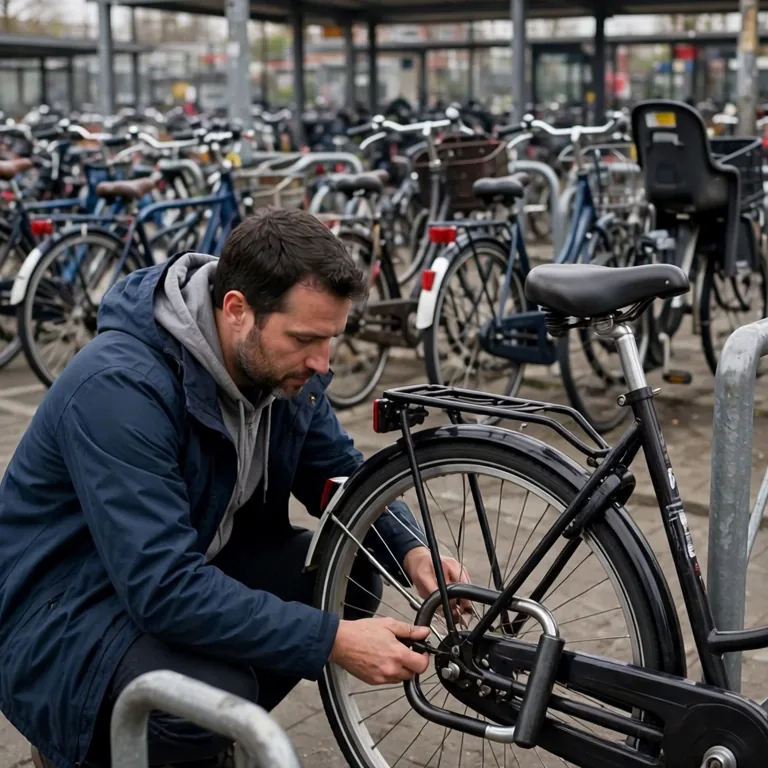
Before you ride, check the bicycle, the seller and the rules
If you are buying a second-hand bicycle in the Netherlands, first look up its framenummer (frame number) in the theft registers. Check the brakes, tyres, wheels, lights and bell, and ask for a receipt. Obey the rules that apply to your kind of bike, lock it with two locks when you can, and leave it in a designated parking spot. If the bike goes missing, check the municipal depot before you report a theft.
Decide between a shop, a private seller or a subscription
At a fietsenwinkel (bike shop), staff can help you find the right fit and can sell you a used bike that has been serviced. Compare that price with what private sellers ask. In a private sale, you must inspect both the bicycle and the seller yourself. In a subscription, you pay each month to use a bicycle owned by the provider. Before you sign, find out what repairs the fee includes, how long the contract lasts, how to cancel it, and what the terms are if the bike is stolen.
If you are looking at an e-bike (electric bike), test the battery, charger, display and assistance as well. Ask how old the battery is and request the key, the original charger and the service history. A battery that is worn out may lead to an extra cost for a replacement. ANWB (Dutch road users’ association) checks for buying a used e-bike cover a battery test and checking whether a replacement is available.
Inspect a second-hand bicycle before handing over money
Carry out the following checks in the order shown. Take a test ride, as explained in ANWB’s second-hand bike checklist.
- Before the meeting, request the brand and the frame number.
- When you view the bike, make sure the number on it is the same as the one you were sent, and that it has not been covered up, changed or damaged.
- Look up the brand and frame number in the RDW (Dutch vehicle authority) stolen-bike register. If the bicycle appears as stolen, do not continue with the purchase.
- Use the politie (police) Stop Heling (stolen-goods check) to check the frame number. If the result says the bicycle is stolen, do not buy it.
- If Stop Heling gives a stolen result, use the report button that appears in that result.
- Examine the seller’s explanation and make sure the keys work. A price that is much lower than similar offers, keys that are missing, a history that is unclear, or pressure to pay fast are all reasons to pause and investigate more.
- Check how the brake or brakes, steering, tyres, wheels, chain, gears, lights and bell work.
- Look over the bicycle for cracks, a frame that is bent, and parts that are loose.
- On an e-bike, test both the battery and the charger.
- If they are available, ask for the original receipt or the service records.
- Obtain a written receipt that states the date, price, description of the bike, frame number, and the details of both buyer and seller.
- Make sure the frame number on the bicycle is the same as the one on the receipt.
- Do not pay until you have seen the bicycle and finished these checks.
Warning
A clean result in the register is not proof that the sale is lawful
The RDW register contains reports made from 1 January 2008 onwards, plus some reports from before that date. Thefts that were never reported do not appear. A new report may take as long as 10 days to show up. Treat the result as one part of checking the seller and the offer.
Heling (handling stolen goods) can cover getting, keeping or selling stolen goods. When you buy something, whether you are criminally liable depends on whether you knew, or reasonably should have suspected, that the bicycle was stolen at the time you acquired or received it. A register check by itself does not answer that question.
Find out which bicycle rules apply to you
The legal category determines the documents and equipment you must have. Rijksoverheid (Dutch government) sets out the rules below for electric bikes.
Wide tables can be scrolled sideways.
| Bike type | Motor assistance | Requirements before riding |
|---|---|---|
| Ordinary bike | None | No driving licence, number plate, compulsory helmet or compulsory motor liability insurance. |
| Standard e-bike | You must pedal; assistance stops at 25 km/h; motor up to 250 watts. | Ordinary cycling rules apply. No driving licence, number plate, compulsory helmet, minimum age or compulsory motor liability insurance. |
| Speed-pedelec (fast electric bike) | Pedal assistance up to 45 km/h; legally a bromfiets (moped). | Age 16 or older; AM (moped), B (car) or A (motorcycle) driving licence; yellow number plate; wettelijke aansprakelijkheid (WA, third-party liability) insurance; approved helmet. |
A speed-pedelec must obey the route and speed rules for mopeds. Where there is a shared bicycle and moped path, use it; if there is not, use the carriageway. The speed limits are 30 km/h on shared paths within built-up areas, 40 km/h outside built-up areas, and 45 km/h on the carriageway. Before you ride, check the speed-pedelec rules.
On a standard e-bike, a throttle may move the bike without pedalling only up to 6 km/h. If assistance works above 25 km/h, or if throttle power goes above 6 km/h, the bike needs approval in a different motor-vehicle category. If it does not have that approval, you may not ride it on public roads. Before buying, ask the seller which category the bike is in.
Check the equipment that is required
These checks apply to ordinary two-wheeled bicycles and standard e-bikes. Cargo bikes with more wheels may require extra lights or reflectors; see the government’s lights and reflectors rules.
- Your bicycle must have a brake and a bell that work. If a bicycle has only rim brakes, it must have two separate working brakes that act on two wheels. The Regeling voertuigen (Vehicle Regulations) states these requirements.
- When it is night or visibility is poor, use a front light that is steady and white or yellow, and a rear light that is steady and red. Make sure the lights can be seen. They must not flash or blind other people.
- Attach a red rear reflector that is not triangular, white or yellow reflectors on the wheels or tyres, and four amber or yellow reflectors on the pedals.
- If you use loose lights, attach them to the bicycle, a bag, your chest or your back, and point them straight ahead or straight behind. You are not allowed to wear them on your head, arms or legs.
As part of maintenance, set the saddle to the right height and check the tyre pressure, steering, chain, lights, brakes and any loose parts before you use the bike regularly.
Take a small spare light with you. Put it in a position that is allowed, and make sure it stays visible when you use it.
Obey the traffic rules and check the fines for 2026
In 2026, cyclists face these four administrative fines. The Openbaar Ministerie (OM, Public Prosecution Service) Boetebase (fine lookup) lists the precise offence and the amount. Every amount shown does not include the €9 administration costs.
Wide tables can be scrolled from side to side.
| Offence | 2026 fine, excluding administration costs |
|---|---|
| No required lights, or faulty lights, in darkness or poor visibility | €75 |
| Passing a red light | €120 |
| Holding a phone or other mobile electronic device while riding | €170 |
| Not using a mandatory bicycle path or shared bicycle and moped path | €75 |
As an example, in 2026 a €75 fine for lighting becomes €84 once the €9 administration costs are added. The amounts here apply to cyclists; fines for other vehicle categories may differ.
While riding, holding a phone, tablet or music player is not allowed. Hands-free operation, or using a device placed in a holder, is permitted only when it causes no danger. When you are stationary, you may hold and use the device.
On an ordinary bicycle or a standard e-bike, the blood alcohol limit is 0.5 promille (parts per thousand). Alcohol offences are handled under criminal law and do not carry one fixed administrative fine. The table above concerns other offences; it does not indicate whether drinking alcohol is safe.
Where a mandatory fietspad (bicycle path) or fiets/bromfietspad (shared bicycle and moped path) exists, use it. If neither exists, use the carriageway. A bicycle with more than two wheels, or one pulling a trailer, is allowed on the carriageway when its width including the load is more than 0.75 metres. If you are on the pavement, walk your bike.
For an ordinary bicycle or standard e-bike, a helmet is recommended. On a speed-pedelec it is compulsory: wear an approved moped helmet or speed-pedelec helmet. The approved-helmet rules explain which types are approved.
Secure the bicycle and note its details
When you park, apply these checks to prevent theft. The police bicycle-security advice advises locking the frame to a fixed object and, where possible, using two different locks.
- Where possible, use the frame lock together with a separate strong chain or U-lock. Check for an ART (lock approval mark) rating in the Stichting ART (lock certification foundation) database.
- Pass the second lock through the frame and secure it to a bicycle rack or another fixed object if this is permitted. Do not block pavements, exits or emergency routes.
- If one is available, use a guarded bicycle parking facility for a valuable bike. If practical, take off an e-bike display or battery key.
- Take a photograph of the bicycle and its frame number. Store the receipt, lock details, spare keys and e-bike battery details somewhere separate from the bike.
Review theft and liability insurance
A separate bicycle policy is optional and may cover theft or damage, depending on the policy. In some situations, contents insurance can cover a stolen bicycle. Check if it covers theft from the street and from your storage place, and which countries are included.
Compare the premium against the bicycle’s replacement value. Read every condition about locks, second locks, keys, trackers and reporting. Since these are policy terms, check what your own insurer requires. The Verbond van Verzekeraars (Dutch Association of Insurers) theft guidance explains why insurers may request evidence about locks and keys.
Aansprakelijkheidsverzekering voor particulieren (AVP, personal liability insurance) may cover damage you accidentally cause to another person while cycling. The conditions are set by your policy. This cover is separate from theft or damage cover for your own bicycle. A standard e-bike does not require compulsory WA motor insurance; a speed-pedelec does. The liability and contents insurance guide explains the difference.
Check the depot before you report a theft
If your bicycle goes missing, take these steps:
- Look carefully at the location.
- Ask parking staff nearby if they know what happened to the bicycle.
- Check the website of your gemeente (municipality) and the fietsdepot (municipal bicycle depot), especially if you parked near a station, shopping area or restricted zone.
- If the bicycle is not at the depot, report bicycle theft to the police. Provide the frame or chip number, brand, model, colour, photographs and distinctive features.
- Keep the confirmation of the report.
- If applicable, tell your bicycle insurer or subscription provider without delay.
- If applicable, meet the evidence and key requirements of your insurer or subscription provider.
If you see the bicycle offered for sale, save the listing and the seller’s details, then contact the police. Have your purchase receipt and frame number ready. Leave the recovery to the police.
Write down the frame number now
Once the police check a theft report that includes the frame or chip number, they enter the bicycle in the stolen-bike register. A frame or chip number helps the police identify a bicycle that is recovered. Before reporting a theft, check the municipal depot: the municipality may have removed the bicycle.
Review your municipality’s parking rules
Municipalities may remove bicycles that are parked dangerously or block routes, are left outside designated parking in regulated areas, seem abandoned, or remain beyond a local time limit. Notice labels, immediate removal, fees and storage periods vary. Check the instructions from your own municipality.
To see local examples, compare Amsterdam’s bicycle-removal rules, Utrecht’s depot and collection rules and Den Haag’s abandoned-bike rules. Every city has its own notices and deadlines.
When parking or collecting a removed bicycle, check all of these points:
- Use a rack, a marked bay or a bicycle parking facility, and follow the signs nearby. Only attach a bicycle to a lamp post, traffic sign, bridge railing or fence where local rules permit it.
- Leave footways, entrances, tactile paving and emergency routes unobstructed. Check the parking and time limits in station areas and busy centres.
- If the bicycle is gone, search your municipality’s website for fiets verwijderd (bike removed). Check the deadline for collection. Bring the requested identity proof, bicycle key and payment method to the depot.
- If you disagree with the removal, keep the decision and proof of payment. Follow the municipality’s objection procedure.
Get help and document a cycling accident
First, handle any injuries and hazards. After that, write down what took place for those involved and for your insurer.
- Move yourself and other people away from immediate danger. Only move someone who is injured when safety makes it necessary.
- For injuries or immediate danger, dial 112.
- Provide first aid when you are able to.
- Before you leave, swap identity, contact information, and any relevant insurance details with the other party.
- If it is safe, take photos of the road, signs, positions, vehicles, bicycle, and damage before anything is moved.
- Write down the names and contact details of witnesses.
- Put the facts in a Europees schadeformulier (European accident statement), or use the accepted digital form. The police accident guide identifies mobielschademelden.nl (digital accident-reporting service) as the digital route.
- When you use the paper form, tell your insurer within 24 hours, following police advice.
- When a bicycle has no number plate, forward the digital report to your insurer yourself, if this applies.
- When you send your insurer a digital report, make sure receipt is confirmed.
- Get medical advice for pain or symptoms, even if the symptoms show up later.
- Retain repair quotes, medical records, receipts, and other proof of costs.
When police come to a collision
Police usually come when there are injuries, major damage, suspected drink-driving, driving without a licence or required insurance, aggression, disagreement, or a road that cannot be cleared. In a minor collision with none of these issues, the people involved normally exchange details and deal with the claim on their own.
Resolve common bicycle problems
The offer for a used bike seems wrong
A theft-register search that returns no match is just one check. Turn down the offer if the seller refuses to show the frame number or keys that work, if the number appears changed, if the story keeps changing, or if the price is much lower than similar offers. Keep a copy of a suspicious online listing. When Stop Heling gives a stolen result, use the report button shown in that result.
The bicycle you bought turned out to be stolen
Do not use or sell the bicycle; contact the police. Keep the listing, messages, payment record, and receipt. A database check by itself does not prove ownership or shield you from prosecution. For the purchase, the facts decide whether you knew, or reasonably should have suspected, that the bike was stolen when you acquired or received it.
Your insurer denies the theft claim
Request the decision and the policy clause in writing. Compare these with the evidence you kept about the lock, key, tracker, parking, and reporting. If the facts do not match the decision, use the insurer’s complaint process. Before you buy the lock or bicycle, check the conditions of a new policy.
Go on with these guides for your travel plan and insurance:
- Public transport in the Netherlands
- Liability and contents insurance in the Netherlands
- Cost of living in the Netherlands
Official Sources
- Regeling voertuigen: bicycle equipment requirements - The current legal requirements for a working brake or brakes and a working bell.
- Rijksoverheid: standard e-bike rules - The legal e-bike definition, road rules, phone and alcohol rules, and no separate compulsory WA insurance.
- Rijksoverheid: moped and speed-pedelec rules - The licence, plate, insurance, route and speed rules for speed-pedelecs.
- Rijksoverheid: compulsory helmets - The approved-helmet requirement for speed-pedelec riders and passengers.
- Rijksoverheid: bicycle lights and reflectors - When lights are required, permitted light positions and the compulsory reflectors.
- Reglement verkeersregels en verkeerstekens 1990 (RVV 1990, Traffic Rules and Signs Regulations) - Current rules on cycle paths, carriageways, walking a bike and helmets.
- Openbaar Ministerie: Feitenboekje (offence schedule) 2026 - The official 2026 offence codes and cyclist-category fine amounts.
- Staatsblad (official gazette) 2025, 413 - The decision indexing administrative traffic fines from 1 January 2026.
- Openbaar Ministerie: Boetebase - Current fine amounts and offence wording; the listed fines exclude €9 administration costs.
- RDW: check whether a bike is stolen - How to search by brand and frame number, the identifying details needed for registration, and the register’s processing delay and limits.
- Politie: check for stolen goods - The Stop Heling serial-number check, warning signs and reporting route.
- Politie: report bicycle theft - The depot-first advice, reporting routes and the importance of the frame number.
- Rijksoverheid: what to do if a bike is stolen - Police reporting, frame or chip numbers, the stolen-bike register and municipal depots.
- Stichting ART: approved-lock database - How to verify whether a lock has ART certification and its star rating.
- Verbond van Verzekeraars (Dutch Association of Insurers): stolen bicycle - Why contents and bike cover vary and why policy conditions, keys and evidence matter.
- ANWB: bicycle-insurance prevention terms - A current policy example showing that lock, second-lock, key, tracker and reporting terms are insurer-specific.
- Politie: what to do after a traffic accident - Safety, emergency help, exchanging details, recording damage, insurer notice and medical follow-up.
- Politie: attendance at traffic accidents - When police normally attend and when parties usually handle a collision themselves.
- Gemeente Amsterdam: bicycle removal - One municipality’s designated-area, obstruction, notice and immediate-removal rules.
- Gemeente Utrecht: bicycle removed - Utrecht’s local depot fees, storage periods, proof requirements and objection route.
- Gemeente Den Haag: abandoned bicycles - Den Haag’s different labelling, removal and depot procedure, showing municipal variation.
- ANWB: buying a second-hand bike - Test rides, fit, brakes, tyres, steering, wheels and frame checks before buying.
- ANWB: buying a second-hand electric bike - Battery testing, replacement availability and checks for wear before buying.
- Politie: preventing bicycle theft - Two locks, securing the frame to a fixed object, parking and recording identifying details.
- Interpolis: personal liability insurance - An insurer-specific example of liability cover for damage to others while cycling and motor-vehicle exclusions.
- Politie: a purchased bike turns out to be stolen - Criminal liability depends on whether the buyer could have suspected theft; keep the receipt and check the frame number.
- Politie: your stolen goods appear for sale online - Reporting an online offer with purchase proof, serial number, seller and advertising-site details.
- Wetboek van Strafrecht (Criminal Code): heling (handling stolen goods) - Articles 416 and 417bis: knowledge or reasonable suspicion when acquiring or receiving stolen goods.
- Reglement rijbewijzen (Driving Licence Regulations): minimum age - Article 5: the minimum driving age for licence category AM is 16.
- Burgerlijk Wetboek Boek 3 (Civil Code, Book 3): ownership of stolen goods - Article 86: good faith and the shop-purchase exception matter; a register check alone does not establish ownership.
- ANWB: bicycle lease and subscription contracts - Subscriptions charge for use, maintenance and repairs while the provider owns the bike; lease and subscription conditions differ.
- Mobielschademelden.nl: digital accident report - The digital accident-reporting service named by the police; ANWB confirms that cyclists can use it.
- Gemeente Ommen (Municipality of Ommen): digital accident reports - Automatic insurer forwarding applies to vehicles with number plates; users without plates can forward the report themselves.
- ANWB: accident registration for cyclists - Cyclists can register accidents digitally; accident registration and sending a report to an insurer are separate.