
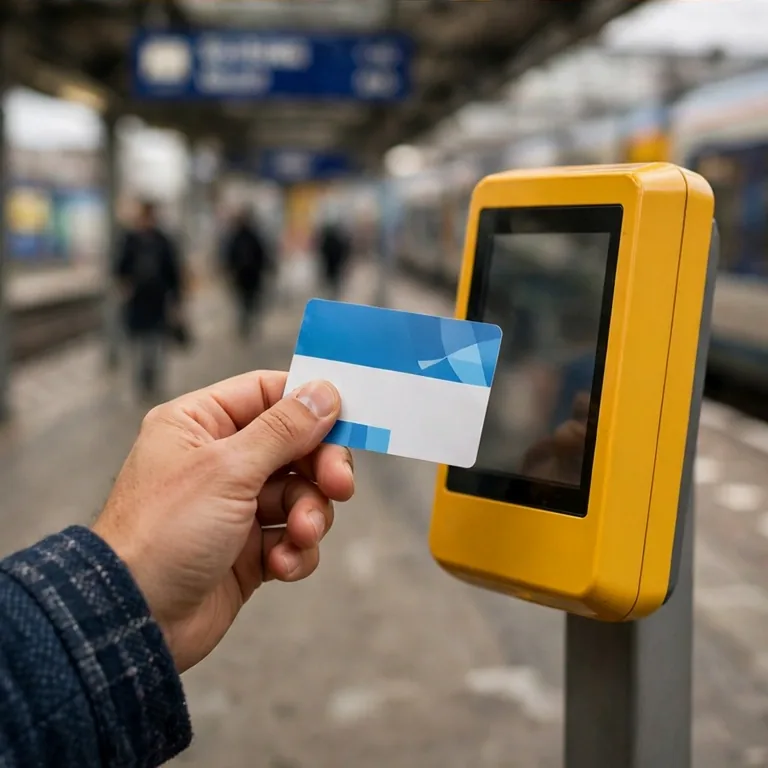
Use the same card or device to tap in and tap out
For train, bus, tram and metro journeys, OVpay (public-transport payment system) is available. Use the same contactless bank card, phone or watch to tap in and tap out. Every traveller who checks in needs a separate card or device. If you travel by train with a standard bank card, you pay the full second-class fare. For payments from balance, use an OV-pas (prepaid travel card). If a product still requires it, keep your OV-chipkaart (public-transport smart card).
This guide is intended for newcomers who plan everyday trips inside the Netherlands. Plan your route and look up its fare in 9292 (public-transport journey planner).
What card or device should I choose?
Every traveller must have their own card or device. A phone wallet and the matching plastic card are counted as two separate cards, even if they are linked to the same bank account. You do not have to buy a travel card to use a bank card. Current NS (Nederlandse Spoorwegen, Dutch Railways) subscriptions still require a personal OV-chipkaart.
Wide tables can be scrolled sideways.
| Option | 2026 cost | How it works and its limits |
|---|---|---|
| Contactless bank card, phone or watch | Nothing to buy | Many Dutch and foreign contactless Maestro, V PAY, Mastercard and Visa cards work. Some issuers and card types are excluded. Fares come from your bank account after travel. Standard bank-card train travel is second class at full fare. |
| OV-pas | €6; valid for up to 5 years | Load prepaid balance or use automatic top-up. It works with all main operators. Check whether your subscription can use it. Current NS travel is second class at full fare. |
| Personal OV-chipkaart | Normally €7.50; sometimes included with a subscription | Load balance or add a travel product. Current NS subscriptions, Kids Vrij (free train travel for children), the studentenreisproduct (student travel product) and OV-fiets (station bicycle hire) still use it. Keep the card until your provider tells you to switch. |
Is it possible to switch to an OV-pas?
With the OV-pas, you pay from a prepaid balance. Order it via OVpay and add balance before you travel. You can also enable automatic top-up. A Dutch bank account is required for automatic top-up.
The OV-chipkaart is being withdrawn, but certain products still require it. Anonymous OV-chipkaarten have not been sold since 1 July 2026. According to NS, existing anonymous cards may still be used until the end of 2027. Personal cards that carry products do not all stop on a single date.
NS will begin moving subscriptions at the end of 2026. The migration will continue until the end of 2027. NS will let you know when you should switch. Continue using your current card until NS or your other provider tells you to switch. The Switch Helper on OVpay shows which option matches your products.
Have a second payment method with you.
Certain foreign contactless cards are not accepted. If your card does not work, carry a second accepted card or buy a ticket from the operator. Pick one card or device for the entire trip. Add it to the OVpay app so you can view charges and fix incomplete journeys.
What are the steps for checking in and out?
Checking in marks the beginning of your journey. The matching check-out allows the operator to work out your fare. Do these steps even at stations that have open platforms.
At train stations, you will find readers at gates or on poles. On buses, readers are next to the door. On trams, readers are usually inside the vehicle. In the Utrecht region, they are located on the platform. The operator’s name is shown above its reader. NS readers are yellow.
- Pick one card, phone or watch and use it for the entire journey.
- Locate the reader belonging to the correct operator.
- Tap in on that reader before you travel.
- Make sure the reader accepts your tap.
- When your journey ends, tap out on the correct operator’s reader with the same card or device.
If you change buses or trams, tap out of each vehicle and then tap into the next one. If you change trains but stay with the same operator, remain checked in unless you go through exit gates. If the operator changes, check out first and then check in again. The same applies when you change from a bus to a train.
For NS, if you check out at the same station within 60 minutes, the check-in is cancelled and no fare is charged. After 60 minutes, a charge may apply. Check out within six hours of checking in. For NS travel paid from OV-chipkaart balance, check out before the service day ends at 04:00, if that time comes earlier. If you miss the window, correct the journey afterwards.
If a tap does not work while you are still at the station, try the correct reader or ask staff for help. If you are already on the train without a valid check-in, tell the conductor before an inspection. A fine can still be issued.
What will my journey cost?
In 2026, a standard balance fare for bus, tram or metro begins with a €1.16 base fare. The operator or region adds its distance rate. Special services and tickets may have a different price. Check the planned fare in 9292.
The Cost of living in the Netherlands guide places transport costs alongside rent, food and insurance.
Daily caps vary by operator and product. GVB (Gemeentevervoerbedrijf, Amsterdam’s public-transport operator) offers GVB Max (daily fare cap), which is a €10.50 daily cap in 2026. GVB Max is not a national daily cap. Use the same bank card, device or OV-pas and complete every check-in and check-out. The cap does not include OV-chipkaart travel, night buses or other operators.
The standard full NS train fare depends on your route and does not change between peak and off-peak hours. Travel with a standard bank card costs the full second-class fare. In 2026, a one-way trip between Schiphol Airport and Rotterdam on Intercity direct (high-speed train service) or Eurocity Direct (high-speed train service) requires a €3.20 supplement when you use a bank card or an ordinary domestic ticket. Some paper tickets bought from a machine or service desk have a €1.60 surcharge.
Bank-card journeys made on one day usually show up as a single payment the next day. OVpay may collect earlier if you reach its payment threshold. Your bank statement displays an 18-character NLOV (public-transport payment reference). Use that reference and the charged amount to look up your journeys without an account. The OVpay app also lists your trips.
OV-chipkaart balance travel uses an instaptarief (temporary boarding charge). NS takes €20 if you have no subscription, or €10 with a balance-based NS subscription. For example, Gelderland buses use €4 in 2026. After check-out, the correct fare replaces this amount. Check your operator’s boarding charge before you travel.
Which subscription is right for my route?
Current NS subscriptions require a personal OV-chipkaart. When NS contacts you, you can move yours to an OV-pas. Some regional train, bus, tram and metro operators already offer products for a bank card or OV-pas. Check both the route and the card that the product requires.
Dal Voordeel (off-peak discount subscription) costs €6.35 per month at the standard adult rate in 2026. It provides 40% off eligible off-peak train travel. The fee is equal to 40% of about €15.88, so it begins to save money once eligible full-fare travel goes above roughly €16 a month.
For example, €20 of eligible full-fare journeys becomes €12 with the 40% discount. Add the €6.35 fee, and your monthly total is €18.35, a saving of €1.65.
Dal Voordeel provides a discount. The other options listed include unlimited travel during the listed hours. These are standard adult second-class NS Flex (monthly billed travel) prices for 2026.
Wide tables can be scrolled sideways.
| NS Flex subscription | 2026 monthly price | Benefit |
|---|---|---|
| Dal Voordeel | €6.35 | 40% off eligible off-peak train travel |
| Weekend Vrij (weekend unlimited travel) | €39.50 | Unlimited weekend train travel. This price excludes the optional off-peak discount add-on. |
| Dal Vrij (off-peak unlimited travel) | €127.95 | Unlimited train travel in off-peak hours, at weekends and on recognised public holidays. |
| Altijd Vrij (unlimited travel at all times) | €399.95 | Unlimited train travel at all times. |
For regular bus, tram or metro travel, compare your route in the 9292 instructions for choosing a season ticket. A day ticket or monthly product may be cheaper. It might cover only one operator, zone or payment method.
At what times are off-peak discounts available?
On weekdays, NS treats off-peak hours as before 06:30, between 09:00 and 16:00, and after 18:30. Weekends and recognised public holidays are included too. Consult NS's holiday list, because not every commemorative day qualifies each year.
NS gives a five-minute margin on either side of off-peak hours. Your journey must begin within 30 minutes after you check in. Under NS Flex, the first check-in sets the rate when you check in with the following train operator within 35 minutes after checking out. If you use a balance-based discount product, every check-in with a new operator has to fall in off-peak time.
How can I use Samenreiskorting (the co-travel discount)?
At eligible times, Samenreiskorting provides a 40% discount for as many as three companions. A person with an eligible NS subscription or student travel product shares a code. That code remains valid for three days. Before travelling, each companion uses it either to buy a Samenreisticket Dal (off-peak co-travel ticket) or to add the discount to NS Flex Basis (travel without a discount subscription) or NS Flex Weekend Vrij.
This ticket works only in off-peak hours, even if your trip began earlier. If you have eligible NS Flex, the check-in time determines the rate, which means you can remain on the train once peak hours start. You and your companions must be in the same compartment and carry identification. The discount requires the ticket or an eligible NS Flex product; a normal bank-card tap or OV-pas cannot be used for it.
What discounts are available for children and older people?
Children younger than 4 ride free and do not need a card. For older children, the fare depends on the type of transport and the product. Kids Vrij applies to regular train travel; Railrunner (children's train day ticket) is a day ticket. Age discounts for bus, tram and metro follow different rules.
Wide tables can be scrolled sideways.
| Product or age | Transport | 2026 fare benefit | Conditions |
|---|---|---|---|
| Kids Vrij | NS and almost all regional trains, including peak hours | €0 per month for ages 4–11 | Each child needs an active product on their own personal OV-chipkaart. They must travel with someone aged 12 or older who has a valid ticket. One companion may take up to three Kids Vrij children. The child must travel in the same class and on the same route as the companion. |
| Railrunner (children’s train day ticket) | Train | €2.50 for ages 4–11 | You can use it while arranging Kids Vrij. |
| Children aged 4–11 | Bus, tram and metro | 34% off standard balance fares | A personal OV-chipkaart applies it automatically. With OVpay, register the age discount on each card or device. Some cities and operators offer extra local schemes; check your route. |
| People aged 65 or older | Bus, tram and metro | 34% off standard balance fares | A personal OV-chipkaart applies it automatically. With OVpay, register it on each card or device. Train discounts use separate products. |
How do ferries and bicycles fit into my trip?
9292 plans trips that involve multiple operators and shows fares, disruptions and accessibility details. Before you travel, confirm each ferry part of the route with the ferry operator.
For a fare issue, a correction or a service problem, contact the operator.
Ferry payment rules are not the same: some take OVpay, some cost nothing, and others sell their own tickets. Before travelling, check the ferry that appears on your route.
To use OV-fiets, you need a personal OV-chipkaart. New users must have NS Flex; NS Flex Basis charges no subscription fee. Standalone OV-fiets subscriptions that already exist continue to work, but NS does not offer new ones anymore. The rental must be opened with your OV-chipkaart; bank cards and the OV-pas cannot open it at this time.
During 2026, renting an OV-fiets costs €4.80 for each 24 hours in the first three days. From day four onward, the price increases to €9.80 per day. You may rent it for no more than seven days.
If you want to bring your own standard bicycle on normal domestic train services, purchase a Fietskaart Dal (off-peak bicycle ticket). In 2026, it costs €8.50. On weekdays, you may travel with it from 09:00 to 16:00 and from 18:30 to 06:30. At weekends, in July and August, and on public holidays other than King's Day, travel is allowed all day. There is limited space; when the bicycle area is full, wait for a later train.
A standard bicycle is not allowed on a domestic journey with ICE (international train service), Eurostar (international train service) or Nightjet (international train service). On Eurocity Direct and EuroCity (international train service), travelling in peak hours or in July or August requires an international bicycle ticket and a bicycle reservation. At other times, their domestic routes require a bicycle ticket, but no reservation.
A bicycle that is fully folded and measures less than 45 × 86 × 80 cm can be taken free of charge at any time of day. Before you leave, check the NS bicycle rules.
How can I plan an accessible journey?
The 9292 accessible-journey instructions explain how to plan a route that takes stops, stations and vehicles into account. Accessibility differs between operators and vehicles. Check the operator's size limits for a wheelchair or mobility scooter.
For a journey with NS, ask for NS Reisassistentie (travel assistance) no later than one hour before departure. NS advises booking no more than three days in advance. You can use the NS app, the website or the assistance phone line. Find out what help your station provides, and be at the agreed meeting point 15 minutes before departure.
How can I resolve a payment or service problem?
What should I do if I forgot to check out?
If a journey is incomplete, you receive a correction or boarding charge rather than the actual fare. The amount varies by operator, class and card. In 2026, for second-class NS travel paid with a bank card or OV-pas, the missed check-out charge is €33.30, and the missed check-in charge is €20.
Select the correction route that matches your payment method:
Wide tables may be scrolled horizontally.
| Payment method | Correction route | Window |
|---|---|---|
| Bank card, phone or watch | OVpay | From six hours after travel and within 60 days. |
| OV-pas | OVpay app | From six hours after travel and within 60 days. |
| OV-chipkaart | Uitcheckgemist (missed check-out refund service), when your operator supports the trip there. | Trips up to 180 days old. |
At present, NS sends OV-pas corrections to the OVpay app. For NS Flex journeys made with NS, use NS's own correction route. If your payment was made with a bank card, phone or watch and you do not have an OVpay account, use the NLOV reference and the charged amount shown on OVpay journeys without an account.
NS permits three missed-check-out corrections in each calendar year. Under NS Flex, manual and automatic corrections are counted together. If an automatic fare reconstruction is wrong, you may dispute it within six months after the journey date. Such a request does not count against the limit, though NS can reject it.
Refund times for bank-card payments vary by operator. An NS refund may take as long as five days. GVB states that its refund or offset can take up to 15 days. Check the outcome for your operator.
If the problem was caused by a broken reader, a disruption or a system fault, contact the operator directly.
What should I do if the reader refuses my card?
What you do next depends on the reason the reader refused the card:
- A bank card can be blocked for public transport because of an earlier unpaid fare. Pay the amount you owe through OVpay. Once the payment succeeds, wait up to 15 minutes before you use the card again.
- Your card issuer or card type might not be accepted. Use a different accepted card, or buy an operator ticket before you board.
- An OV-pas or OV-chipkaart might have insufficient balance or a blocked product. Check the app or account, add credit, or contact the card provider.
What if I used my phone at one end of the journey and my card at the other?
Your phone wallet and your plastic card are treated as separate cards. If you use one at each end, you create two incomplete journeys. Correct both of them in OVpay. For your next trip, use the same card or device at every reader.
What should I do if I get a fine for an invalid ticket?
If your NS check-in did not go through, notify the conductor right away. In 2026, people using NS Flex or the NS-Business Card (business travel card) get a €70 invalid-ticket fine added to their next invoice. Everyone else pays the fare plus €70 if they pay later or pay immediately in cash. Paying immediately by debit card lowers the fine to €50, plus the fare. Other operators decide their own amounts and procedures.
Warning
Choose to pay later when you want to dispute an NS fine.
The deferred-payment route lets you challenge an NS fine. If you pay immediately, you lose that option. Pay the deferred charge by the stated deadline, then send your objection to NS. Should NS accept your objection, it refunds the payment.
When NS payment is deferred, the letter allows 14 days. If you miss that deadline, €20 is added. If another 14 days pass, collection adds €25. Keep the payment reference and evidence for your objection.
What happens if my NS journey is delayed?
In 2026, for eligible domestic NS journeys where you pay the fare, a delay of 30–59 minutes at your final destination gives back 50% of the fare. A delay of at least 60 minutes gives back 100%. If your trips are covered by unlimited travel, compensation depends on your subscription. Outside those times or routes, the fare-paying rules above apply. File your claim within three months. NS does not pay amounts below €2.30.
NS does not cover delays announced before travel, delays caused by another operator, journeys without a valid ticket, or certain cases of force majeure (events outside the operator’s control). High-speed services follow separate rules, including compensation from 15 minutes on some routes. Use the form for your payment method on NS domestic delay refund page.
If NS expects a delay of at least 60 minutes, ask staff or customer service about continuing, returning or taking another route. As a rule, get explicit approval before booking your own taxi or hotel if you want NS to repay it. If another operator caused the delay, claim from the responsible operator.
An exception for alternative transport applies if an NS train failure or delay leaves you stranded at the end of the day. You must be unable to reach home or your final destination that day, and unable to contact NS through any channel after repeated attempts. In that case, you may claim reasonable transport costs without prior approval. Keep proof of the failed contact attempts and your receipt or invoice. This exception does not cover a hotel you book yourself.
What if my complaint has not been resolved by the operator?
For a journey, fine, delay or staff problem, contact the operator first. For an OV-pas, account or OVpay-system problem, contact OVpay. Keep the journey date, times, card reference, screenshots and receipts.
If the operator has not resolved your complaint, the independent Klachtenloket Openbaar Vervoer (public-transport complaints desk) can give advice or mediate at no cost. You can then bring a dispute to the Geschillencommissie Openbaar Vervoer (public-transport disputes committee). The operator must be a member of the committee. Its decision is binding. In 2026, the fee is €27.50; you get it back if the committee rules in your favour. Follow the deadline in the operator’s reply.
How can I get back credit on an old OV-chipkaart?
Any credit on an OV-chipkaart is still yours. Check the card and ask for a refund on OV-chipkaart website, even if the card has expired. If a personal card still carries a product, keep it until its provider confirms the move. Request a refund only for the balance you no longer need.
Use these guides for related tasks:
- First 90 days in the Netherlands checklist helps you set up a bank account and handle other arrival tasks.
- Inburgeringsexamen (civic integration exam) locations explains where exams take place, so you can plan travel to your venue.
Official Sources
- OVpay: Travelling with your debit or credit card - accepted contactless payment credentials, no registration or top-up, one traveller per card, and checking out with the same card or device
- OVpay: OV-pas - the €6 price, five-year validity, balance and automatic top-up, use with all operators, and the warning that not every travel product works on it yet
- OVpay: Arrange it without an account - looking up and correcting an OVpay journey without an account by using the NLOV reference and charged amount
- OV-chipkaart: Travelling with the OV-chipkaart - the end of anonymous-card sales on 1 July 2026, continued use of existing cards, and travel products that still need an OV-chipkaart
- NS: OV-pas, the successor to the OV-chipkaart - NS subscriptions still use the OV-chipkaart; subscription transfers start at the end of 2026, continue until the end of 2027, and NS tells each holder when to switch
- NS: FAQ about travelling with your debit card - foreign-card exceptions, full-fare second-class bank-card travel, one traveller per card, the difference between a phone and a plastic card, and failed-payment recovery
- NS: Checking in and out - using the correct operator reader, changing operators, the six-hour check-out limit, and cancelling an NS check-in at the same station within 60 minutes
- NS: Consumer rates - 2026 NS season-ticket prices, Railrunner, and paper-ticket and high-speed supplements
- Provincial Gazette: Regional public-transport fares for 2026 - the 2026 national base fare of €1.16 for regional public transport, before the regional distance rate
- GVB: GVB Max - the €10.50 GVB-only daily cap, eligible OVpay credentials, and the exclusions for OV-chipkaart, night buses and other operators
- NS: When can you travel with a discount? - off-peak hours, the five-minute margin, the 30-minute start rule, and the different transfer rule for NS Flex and balance products
- NS: Dal Voordeel - the €6.35 monthly price and 40% off-peak train discount
- NS: Co-travel discount - sharing a code with up to three companions, eligible tickets and products, travel-together and identification rules, and the current OV-pas limit
- NS: Kids Vrij - free travel for ages 4–11 on NS and almost all regional trains, with a personal OV-chipkaart and a companion aged 12 or older
- 9292: Discounts for children - free travel under age 4, the 34% bus, tram and metro discount for ages 4–11, and operator-specific local schemes
- 9292: Age discounts - the 34% bus, tram and metro discount from age 65 and the cards that can carry it
- 9292: Season ticket guide - comparing regional and operator season tickets by route, operator and payment credential
- 9292: Journey planner - door-to-door planning across operators and modes, including fares, disruptions, ferries and accessibility information
- NS: How OV-fiets works - NS Flex for new OV-fiets users, continued use of existing standalone subscriptions, 2026 rental prices and the seven-day limit
- NS: Taking a bicycle on the train - standard bicycle ticket and times, international-service exclusions and reservation requirements, free folded bicycles, and limited space
- NS: Forgot to check in or out - what to do while still at the station or already on the train, and the payment-method routes for correcting an incomplete journey
- NS: Correction and boarding rates - the €33.30 missed check-out and €20 missed check-in amounts for second-class NS travel with a payment card or OV-pas
- GVB: Missed check-out - the six-hour to 60-day correction window and GVB refund processing time, showing that operator timings differ
- NS: Paying and appealing a fine - the current NS fine amounts, the debit-card reduction, cash treatment, payment deadlines, added costs and objection rules
- NS: Compensation for delays - domestic fare-based compensation, subscription coverage by time or route, and the narrow end-of-day exception for alternative transport without approval
- NS: Claiming for a domestic delay - the three-month claim deadline, payment-method forms, minimum amount, exclusions and separate high-speed rules
- 9292: Accessible public transport - accessible-route planning and operator-dependent conditions for stops, vehicles, wheelchairs and mobility scooters
- NS: Travel Assistance - booking NS Travel Assistance at least one hour before travel and the assistance channels and conditions
- GVB: Complaint procedure - complaining to the operator first and the next independent mediation and dispute steps
- Dutch Public Transport Disputes Committee - the binding dispute procedure and its fee after a complaint to the transport company
- OV-chipkaart: Check or refund credit - checking and reclaiming credit from an existing or expired OV-chipkaart
- NS: Travelling with an OV-chipkaart - €7.50 personal card, anonymous cards usable until the end of 2027, and €20 or €10 minimum balance for the relevant products
- RET (public transport operator): OV-pas information and services 2026 - €6 card valid for up to five years, Dutch-bank-account condition for automatic top-up, age discounts and the six-hour to 60-day correction window
- NS: Travelling with children - up to three Kids Vrij children per companion, with the active product on each child’s personal OV-chipkaart
- NS: Travel products for adults - NS Flex Dal Voordeel gives 40% off off-peak and weekend train travel
- NS: Travelling with a payment card - daily bank-card charge collection, possible earlier collection, and NLOV followed by 14 characters
- NS: Intercity direct - Schiphol–Rotterdam supplement for Intercity direct and Eurocity Direct with domestic tickets
- Vervoerregio Amsterdam (Amsterdam transport authority): Regional fares for 2026 - 2026 base fare of €1.16 plus regional distance rates for GVB and the transport operators Connexxion and EBS
- GVB: Response on 2026 fares - official confirmation of the GVB Max increase to €10.50 in 2026
- 9292: OVpay - OVpay on trains, buses, trams, metros and some ferries, and the same-card rule
- GVB: North Sea Canal ferry product conditions - free crossings for pedestrians and slow traffic and separate crossing tickets for cars and motorcycles
- Klachtenloket Openbaar Vervoer: Complaint routes - complain to the operator first, then free advice or mediation, and a binding committee decision
- NS: NS Flex product conditions - six-hour check-out condition, same-station cancellation within 60 minutes, three missed check-out corrections per calendar year, and the six-month exception for an incorrectly reconstructed fare
- NS: Conditions for travel on balance - section 2.7: check out within six hours of checking in, or before the service day ends at 04:00 if that is earlier
- NS: OV-pas frequently asked questions - subscription transfers start at the end of 2026 and continue until the end of 2027; NS tells each holder when to switch
- NS: Samenreiskorting instructions - Samenreisticket Dal is the official ticket name; the ticket and NS Flex use different peak-hour validity rules
- 9292: Travelling by tram - tram readers are usually inside the vehicle; Utrecht-region tram readers are on the platform
- 9292: Travelling by bus - bus check-in and check-out readers are beside the door
- NS: Kids Vrij conditions - the child must travel in the same class and on the same route as the companion, alongside the age and ticket conditions
- 9292: Questions about e-tickets - standard full-fare NS tickets are valid all day on their stated date and route; travel time does not change the full fare
- Arriva (public transport operator): Voordeel Jeugd Limburg (Limburg youth discount) - regional train and bus discount products can use a bank card or OV-pas; ordinary NS bank-card rules are not a national product restriction