
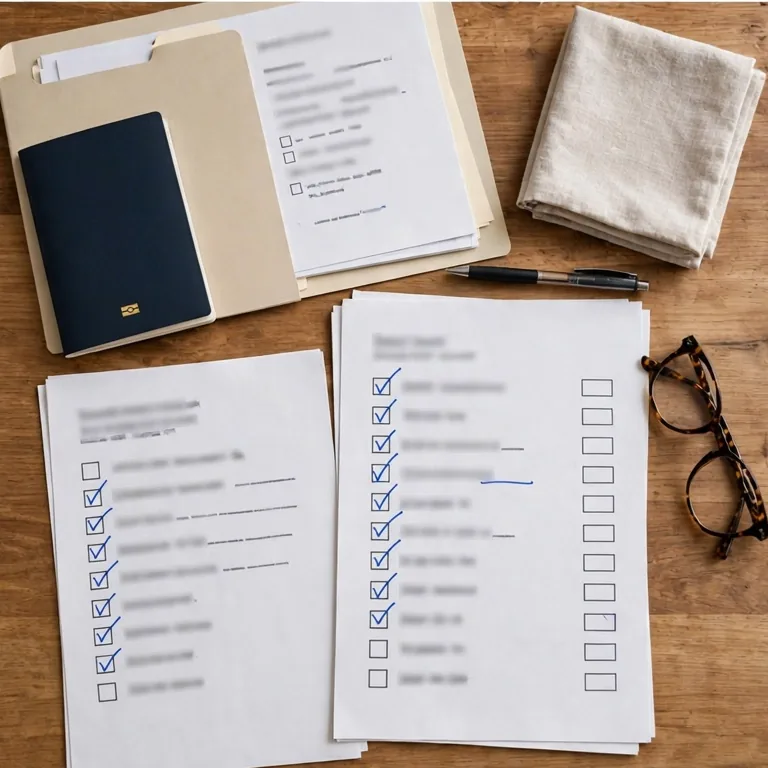
Start by using the checklist of the organisation that will receive your document
Before you move to the Netherlands, begin with the checklist from the organisation that will receive your document. Bring the originals, official copies or scans that it accepts. Use NetherlandsWorldwide to find out if a foreign record requires an apostille (authentication certificate) or a different legalisatie (official authentication) route. Look at translation rules separately. Take care of any steps in the issuing country before you leave.
Check which organisation will receive each document
The documents you need depend on the purpose. Your gemeente (municipality) lists what it requires for registration in the BRP (Basisregistratie Personen, Personal Records Database). Instructions differ by locality. Check your gemeente’s appointment page. The IND (Immigration and Naturalisation Service) application form lists the evidence for your residence route. A school, employer or professional regulator decides what it needs from your diploma.
Use the row that fits your purpose. Prepare every document on that organisation’s checklist, not every document in this table. Check the list before you order, legalise or translate anything.
Wide tables can be scrolled sideways.
| Purpose | Ask first | Prepare only if requested |
|---|---|---|
| BRP and civil status | The gemeente where you will live | Passport, proof of address and the original or official civil-status records on its appointment list |
| Residence permit or MVV (provisional residence permit) | The exact IND route page and application form | The listed identity, sponsor, relationship and other evidence for your route. Legalise and translate official foreign records when required. |
| Study | The Dutch educational institution | Diploma and grade list. Many institutions obtain level advice themselves, so ask before ordering an evaluation. Check IDW (international credential evaluation service) study guidance. |
| Work | The employer or the authority for a regulated profession (a job requiring official recognition) | Diploma, grade list and any professional-recognition evidence. An IDW evaluation is usually optional for work outside regulated professions. |
| Driving | The RDW (Dutch vehicle and driving-licence authority) exchange checker | Valid licence, any required translation and the documents for an exchange through your gemeente. |
Order the correct civil-status records
Order only the records that your residence route or gemeente names. These can include a birth, marriage, registered-partnership, divorce, adoption or death record, or a declaration of unmarried status. Ask whether the receiver wants an original record, an official extract or an official certified copy. A normal photocopy does not satisfy a request for an official copy.
IND usually accepts records of fixed facts, such as birth or marriage, no matter when they were issued. A declaration of unmarried status must be no more than 6 months old. For example, a declaration issued on 10 April 2026 is too old on 11 October 2026. If you submit it to IND on that date, arrange a newer declaration. Your gemeente can set its own instructions for submission.
Amsterdam’s foreign-document instructions require originals when you submit foreign civil-status records. The Hague’s first-registration page says to bring the civil-status records that you have. If you do not have them yet, you can register and hand them in at a later appointment. That page is for nationals from outside the EU (European Union), EEA (European Economic Area) and Switzerland. You need proof of lawful residence and must plan to live in The Hague for at least 4 months. You must also have no earlier Dutch registration and no BSN (burgerservicenummer, citizen service number).
IDW requires clear colour scans of the whole document, with all information readable. Send originals, certified copies or legalised documents only when IDW asks for them. Follow the current page of your own receiver.
Choose the right legalisation route
The legalisation route depends on the country or territory that issued the document and on the document type. Use the NetherlandsWorldwide country page to choose the applicable row below. Whether a country belongs to the apostille system by itself does not determine the answer.
Wide tables can be scrolled sideways.
| Document route | What to do |
|---|---|
| Covered public document from another EU country | Use it without legalisation. Check that the document type is covered. A multilingual standard form can help with translation; attach it to the underlying record. |
| Document covered by the Apostilleverdrag (international agreement on document authentication) | Get one apostille from the approved authority in the issuing country. Check that the country, territory and document type are covered for use in the Netherlands. |
| Document requiring full legalisation | Follow the country page in order. The process may involve the issuing authority, a ministry and a Dutch embassy or consulate. |
| Document from Aruba, Curaçao, Sint Maarten, Bonaire, Saba or Sint Eustatius | You can use the document elsewhere in the Kingdom of the Netherlands without legalisation. |
An apostille is a stamp, sticker or separate certificate that authenticates the signature and the official issuer. Full legalisation involves more than one authority. Legalisation checks the official signature, seal or stamp; the receiver can still verify the facts in the document. Translation is a separate step.
Check the official route for the issuing country, not a country list from a blog. For example, the Netherlands does not recognise apostilles from Bangladesh or Pakistan. If you have Dutch nationality, Consulair Dienstencentrum (CDC, Consular Service Centre) may be able to help for a listed country. Check that option before you pay a private agency.
Check the order for translation
For an IND application, documents in Dutch, English, French or German do not need translation. Documents in other languages must be translated into one of these four languages. In the Netherlands, use a beëdigd vertaler (sworn translator) who has been sworn in by a Dutch court.
You can also have the translation made abroad. In that case, usually both the document and the translation need legalisation. Follow the issuing country’s rules for the translator and for the order of these steps. An apostille on the original covers that document; check separately what the translation requires. Keep the original-language record together with its translation for submission.
According to NetherlandsWorldwide’s India instructions, for instance, a Hindi document translated in India must have a sworn translation, and both documents need apostilles. If the translation is done in the Netherlands, the original first has to be apostilled in India. Then a sworn translator in the Netherlands translates it; that translation does not need legalisation.
Prepare diploma evidence for your purpose
When a foreign qualification is compared with a Dutch education level, this is called a diplomawaardering (credential evaluation). It counts as advice only; it is not a legally binding decision. The school still makes the admission decision, and a regulated profession has its own recognition procedure. Legalisation is handled as a separate check.
Choose the row that matches your plan before you order an evaluation. An IDW evaluation is often optional.
Wide tables can be scrolled sideways.
| Your plan | First step |
|---|---|
| Apply to a Dutch course | Ask the institution first. Most institutions receive free level advice and make their own admission decisions. |
| Apply for work outside regulated professions | Ask the employer. An evaluation is usually optional, although an employer may request one. |
| Enter a regulated profession | Contact the profession’s authority first. Credential evaluation alone is not professional recognition. |
| Use the inburgering (civic integration), naturalisation or permanent-residence route | Check IDW’s free-evaluation conditions. Eligible applicants can receive one free evaluation; its document rules differ. |
Prepare documents and translations for IDW
Collect the education documents listed on IDW’s required-document list: your diploma and a complete grade list or diploma supplement. Upload proof of a name change if your identity document and diploma show different names. Make clear colour scans of every page. IDW evaluates one diploma per application and can ask for extra evidence about your country or earlier studies.
For an IDW work or study application, upload proof of identity that is valid for at least another 3 months. For a free integration evaluation, upload both sides of your residence permit, valid for at least another 3 months, and the required integration letter. For a free naturalisation or permanent-residence evaluation, upload an official document that shows your BSN.
For IDW, documents in Dutch, English, German, French or Afrikaans do not need a certified translation. For other languages, provide a sworn translation unless your institution supplied an English version. Upload that English version together with the original-language document. If you apply for a free evaluation through the integration, naturalisation or permanent-residence route, you need no certified translation.
To get a free evaluation, you must meet certain eligibility conditions. IDW says that if you already have an inburgeringsdiploma (civic integration diploma), you have to use a paid route. The evaluation of your foreign diploma and an exemption from integration exams are separate decisions. For the decision about the exam, check inburgering exemption guide.
Check IDW waiting times and documents that are missing
If you need an IDW evaluation, apply online. IDW reports about 6 working weeks for the initial check, then about 8 working weeks for evaluation once your documents are sufficient. Missing or unclear uploads can add another wait of about 6 working weeks for the initial check. IDW can also ask for more information during evaluation.
Your refugee situation may make it unsafe to request missing education documents. If you have current or former refugee status, you can still apply in that situation. Explain the situation and submit what you have. IDW assesses whether it can evaluate your diploma. With no documents, IDW may provide an Indicatie Onderwijsniveau (estimate of education level) based on the information you give. This estimate differs from a credential evaluation because it uses no education documents.
Check your driving licence separately
Use the RDW checker to see if you can exchange your licence. An EU or EFTA (European Free Trade Association) licence can be exchanged if you meet all RDW conditions. Expired EU or EFTA licences can also be exchanged if you meet the RDW conditions. How long you may drive depends on the issue date, categories and validity.
Normally, a valid licence from outside the EU or EFTA can be used during the first 185 days after you move. After that period, you need a Dutch licence to drive, even if your exchange application is still pending. For Ukrainian licences, there is a separate rule for people covered by the Richtlijn Tijdelijke Bescherming (Temporary Protection Directive). To find out what applies to your situation, check RDW foreign-licence driving rules.
Exchange is limited to the countries, territories and exceptions that RDW lists. These include qualifying cases under the expatregeling (expat tax scheme). If exchange is not available, you need theory and practical tests at CBR (Dutch driving-test authority). Apply for an exchange through your gemeente after BRP registration. foreign driving-licence exchange guide explains the routes and steps.
For an exchange application, RDW requires a translation if your licence uses characters that are not used in the Netherlands, such as Japanese or Greek. Use a sworn translator, embassy or consulate. For a licence issued outside the EU or EFTA, RDW advises an international driving permit if its categories use labels different from A, B, C, D or E. Obtain that permit in the issuing country before departure.
Pack originals and usable backups
Use these checks for every required document. The diploma check applies only if you need to submit education evidence.
- Keep every original or official copy together with its apostille or legalisation pages and, if required, its sworn translation.
- Make clear colour scans of every page, stamp, sticker and translation. Also keep the original when the receiver requires it.
- Carry the exact checklist from IND, the gemeente, school or employer that you used, including its version or the date you checked it.
- Bring any required diploma, complete grade lists and documents that connect different names on your passport and certificates.
- Check the expiry dates on your passport and driving licence. Check the issue-date rule for any declaration that is time-sensitive.
- Keep irreplaceable documents secure and easy to reach while you travel. Use tracked post if you need to send them.
Solve common document problems
If a document is missing or unusable, contact the organisation that needs it. These actions help you check what it can accept before you pay for a replacement.
Wide tables can be scrolled sideways.
| Problem | What to do |
|---|---|
| You have only a scan, but the receiver asks for an original | Ask the receiver which official replacement or alternative it can accept. A scan alone does not meet its original-document requirement. |
| Legalisation is unavailable because of war, conflict or missing authorities | Ask the receiving authority how it will check and assess the document. Legalisation may be impossible; the receiver decides what it can accept. |
| Your diploma and identity document show different names | For IDW, upload proof of your name change, such as a marriage certificate. |
Use the documents after arrival
Make a gemeente appointment that matches your situation, and bring every item on the gemeente's list. If your move requires an MVV or a residence permit, use the evidence list that applies to your route. family-reunification guide and residence-permits overview help you make that choice.
For the order of registration, BSN, DigiD (digital government login) and insurance, continue with these guides:
Official Sources
- NetherlandsWorldwide: Legalisation of foreign documents for use in the Netherlands - the country-and-document checker for foreign records; legalisation is usually arranged in the country where the document originated
- NetherlandsWorldwide: What is an apostille? - what an apostille authenticates, the forms it can take and recognition of foreign e-apostilles in the Netherlands
- NetherlandsWorldwide: Do I need an apostille? - why the answer depends on both document type and issuing country, including many EU public-document exemptions
- IND: Translation and legalisation of documents - IND rules on document languages, sworn translations in the Netherlands or abroad, legalisation and the six-month limit for a declaration of unmarried status
- NetherlandsWorldwide: Countries where the Consular Service Centre can assist with legalisation - the listed countries where the Consular Service Centre may help Dutch nationals obtain or legalise a foreign document
- Nuffic (Dutch organisation for international education): Applying for a credential evaluation - why credential evaluation is advisory, where to apply and why a school or employer still makes its own decision
- IDW: Longer processing times - the estimated queue: about six working weeks for the initial check, then eight working weeks for evaluation; extra uploads restart the initial-check wait
- RDW: Exchanging a foreign driving licence - the live exchange conditions, country list, BRP requirement, municipal application route and alternatives when exchange is unavailable
- NetherlandsWorldwide: What is document legalisation? - the multi-authority route, the limits of authentication and what happens when legalisation is unavailable
- NetherlandsWorldwide: In which countries are apostilles valid? - country and territory coverage, including the Dutch exceptions for apostilles from Bangladesh and Pakistan
- European e-Justice Portal: Public documents - covered EU public documents and multilingual standard forms as translation aids attached to the underlying record
- NetherlandsWorldwide: Legalisation of documents from India - a worked translation example: a Hindi document translated in India needs apostilles on both the original and translation
- Amsterdam: Foreign documents - the local requirement to submit original foreign civil-status documents
- The Hague: First registration with a residence permit - the first-registration route for nationals from outside the EU, EEA and Switzerland; bring available civil-status records, or supply them at a later appointment if you do not yet have them
- IDW: To work - online applications, one diploma per application, optional evaluations and the separate regulated-profession route
- IDW: To study - institution-led admission decisions and free level advice for most institutions
- IDW: Required documents - colour scans, education and name-change evidence, translation conditions and the free-route translation exception
- IDW: Inburgering - conditional free evaluations, the integration-diploma exclusion and the missing-document route for current or former refugees
- RDW: Driving with a foreign driving licence - driving periods, the 185-day limit, international-permit advice and the Ukrainian temporary-protection exception
- Rijksoverheid (Dutch government): BRP registration - registration through the municipality and the BSN issued after registration
- DUO (Dutch education service): Diploma exemptions - exam exemptions depend on qualifying diplomas and DUO’s decision, separately from a foreign credential evaluation
- IDW: Inburgering, Dutch original - the Indicatie Onderwijsniveau (estimate of education level) and its difference from a credential evaluation for applicants with refugee status and no education documents
- RDW: Exchanging a foreign driving licence, Dutch original - the exchange-application checklist, including translation of licences with characters not used in the Netherlands
- RDW: Driving with a foreign driving licence, Dutch original - international-permit advice for licences issued outside the EU or EFTA whose categories use different labels
- The Hague: First registration with a residence permit, Dutch original - bring available civil-status records; if you do not yet have them, submit them at a later appointment
- NederlandWereldwijd (NetherlandsWorldwide, Dutch government information service): Apostilleverdrag (international agreement on document authentication) - the official Dutch treaty name and the countries where apostilles are valid
- IND: Translation and legalisation of documents, Dutch original - the six-month age limit, accepted document languages, Dutch-court sworn translators and country-specific translation procedures abroad
- NederlandWereldwijd: Document legalisation, Dutch original - authentication does not prove the factual content; the receiving organisation can check it separately