
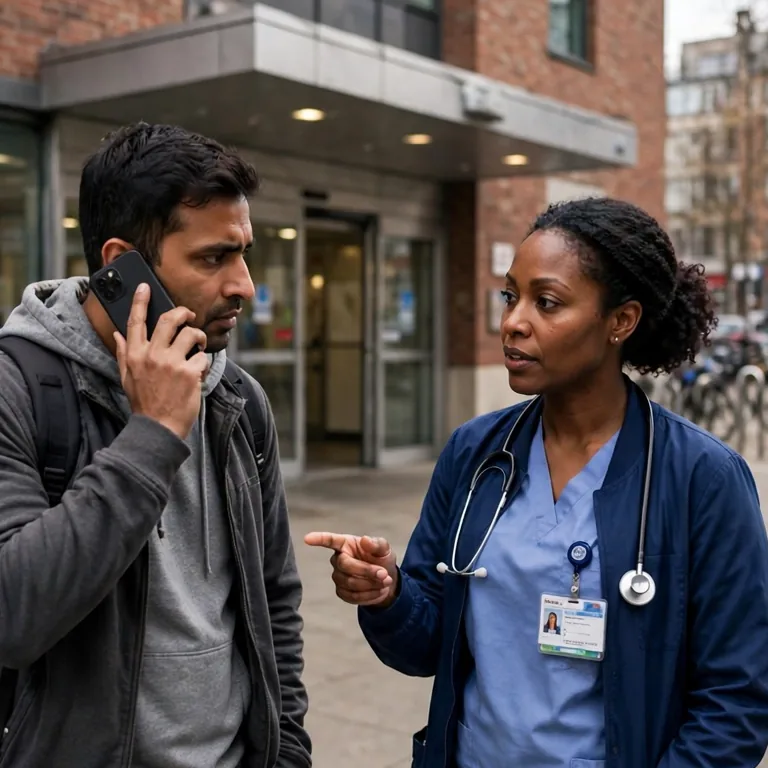
Dial 112 when someone’s life could be at risk
When you believe a person’s life could be in danger, dial 112. If you are staying in COA asylum reception, use the GZA medical helpline that is described below. For other urgent issues outside COA reception, phone your huisarts while it is open. If it is closed and you cannot wait for care, get in touch with the regional huisartsenspoedpost (out-of-hours GP post, also known as huisartsenpost or HAP). Except when life may be in danger, speak to the GP or HAP before you go to a hospital emergency department. Pregnancy, dental, and mental-health problems may have a different first contact.
Urgent care contacts
If you are in COA asylum reception, phone the GZA Praktijklijn at 088 112 2 112 and choose option 1 for medical problems that cannot wait. This urgent line operates day and night. If life is in danger, call 112 right away.
For people outside COA asylum reception, the contacts in the table are for both residents and visitors. Dial 112 if you believe life may be in danger. For other urgent issues, select the contact shown below.
Wide tables can be scrolled sideways.
| Situation | Contact now | What to do |
|---|---|---|
| You think a life may be in danger | 112 | Call now, day or night |
| You need a doctor urgently while your GP is open | Your own huisarts | Use the practice’s urgent phone option |
| Care cannot wait and your GP is closed | Regional huisartsenspoedpost | Contact it first; phone, form or chat options vary by region |
| Possible poisoning | GP or HAP | Call 112 if life may be in danger |
For pregnancy, dental, and mental-health concerns, these are the first contacts. If life may be in danger, the 112 route still applies.
Wide tables can be scrolled from side to side.
| Situation | Contact now | What to do |
|---|---|---|
| An urgent pregnancy concern | Your own verloskundige (midwife) or hospital pregnancy-care team | Use their instructions for urgent calls, including at night |
| A dental emergency | Your tandarts (dentist) or the tandarts on duty | Follow the practice website or recorded phone message |
| A mental-health crisis | Current treatment team, or GP or HAP | Call 112 for immediate danger; 113 Zelfmoordpreventie (suicide prevention service) also helps with suicidal thoughts |
As explained in the Thuisarts.nl (patient information from Dutch doctors) emergency guidance, GP practices usually open on working days between 08:00 and 17:00. Check the opening hours and urgent number of your own practice. If it is closed, also on public holidays, contact the regional post when care cannot wait. The post’s contact details appear on your practice’s website or in its recorded phone message.
If you do not have a regular GP, ask a practice close by for a single consultation while it is open. Outside those hours, phone the post for the area where you are staying. Say that you have no GP. Later, arrange a regular GP through the Finding and using a huisarts guide.
Calling 112
Dial 112 immediately if you think your life or another person’s life may be in danger. The steps below are based on the Rijksoverheid (Dutch government) instructions for a 112 call:
- Call 112.
- Answer the operator’s questions about what occurred, where help is needed, and which service appears necessary: ambulance, fire brigade, or police.
- Keep following the operator’s instructions until the operator says you can hang up.
Calling 112 costs nothing. You can make the call from a mobile even with no credit or no valid SIM (mobile-network card). If you have no SIM, the control room cannot call you back. If the line disconnects, dial 112 again.
The 112NL app (Dutch emergency-call app) transmits the details you entered when you set it up. It shares your location only when you have given permission. Control room staff begin a translated chat if they see that speaking is difficult, or if you said so during setup. You cannot begin that chat on your own.
For the app’s data and chat functions, you need a phone that works, internet access, and a SIM. A regular 112 voice call can still go through without credit or a valid SIM. If these features would be useful to you, install and set up the app before an emergency happens.
If you cannot hear or speak, you can also set up Tolkcontact (communication relay service) or emergency SMS (text messages). Text relay is available around the clock. Sign-language relay operates during fixed hours. Emergency SMS only works if you have registered beforehand.
Out-of-hours GP care
Get in touch with the regional post before you travel to it. Some posts may ask for an appointment; phone, online form, and chat options vary. A triagist (an assistant trained to judge urgency) asks questions and talks with you about the care you need.
The assistant may offer self-care advice, arrange medicine, or ask a GP to call you back. You might receive a consultation, a GP home visit, or an ambulance. The post decides how urgent your situation is. For instance, Huisartsenposten Rijnmond (Rijnmond out-of-hours GP service) sees patients according to medical urgency, not the time they arrived.
If you have the information below, have it ready. If collecting it would delay urgent help, call first:
- The patient’s name, date of birth, location, and a number for a callback.
- The burgerservicenummer (BSN, citizen service number), ID (identity document), and insurance information.
- Medicines, allergies, pregnancy, serious conditions, and recent treatment.
- Details about what changed, when it began, and why it cannot wait.
After the call, keep your phone available and charged so the post can contact you.
Phone before you collect paperwork
A BSN, ID, or insurance card makes administration easier. If life may be in danger, call 112 now. For other urgent problems, contact the right medical service and explain which documents you do not have.
Referrals and costs
For urgent care that is not life-threatening, contact the GP or HAP before you go to the spoedeisende hulp (SEH, hospital emergency department). A doctor can refer you if hospital care is needed. If you think life may be in danger, call 112. Rijksoverheid explains GP and SEH costs.
Under Dutch basic insurance, GP and HAP care has no compulsory eigen risico (deductible). Hospital care, ambulance transport, and some separate services may use your deductible. The table shows the difference for adults aged 18 and older.
Wide tables can be scrolled horizontally.
| Care | What you may pay with Dutch basic insurance |
|---|---|
| GP or HAP advice, consultation or home visit | No compulsory deductible |
| Blood test, scan or other separate diagnostic service | May count toward the deductible; prenatal screening is exempt |
| Prescription medicine and duty-pharmacy service | Usually counts toward the deductible; a co-payment or non-covered amount can also apply |
| Ambulance transport | Counts toward the deductible |
| Referred, medically necessary SEH care | Counts toward the deductible |
| SEH attendance without medical necessity or referral | You pay the full cost yourself |
These coverage rules apply to children, pregnancy care, and dental care. An exemption from the deductible does not mean that every kind of care is covered.
You can move wide tables sideways by scrolling.
| Care | Coverage or deductible exception |
|---|---|
| Basic-package care for a child under 18 | No compulsory deductible |
| Midwifery and maternity care | No compulsory deductible; some related tests, medicine or transport may count. Prenatal screening is exempt |
| Most adult dental care | Usually outside the basic package |
For insured people aged 18 or older, the compulsory deductible is €385 in 2026. As an example, imagine you still have €200 of your deductible left. If you receive €300 of covered hospital care, you pay €200 from that deductible. The insurer pays the other €100. This example assumes full coverage under your policy and no other patient contribution.
Check what your policy covers and which providers it contracts with. In some situations, you may have to pay first. Visitors and patients without insurance follow different billing rules. The Eigen risico deductible guide explains the yearly amount, exemptions, and payment arrangements.
Urgent care for children and for pregnancy
When a child becomes ill suddenly
If a baby under 3 months old has a fever, call the GP or HAP directly. See Thuisarts guidance on fever in children.
Contact the GP or HAP without delay if your child is getting worse. Call directly if your child is worsening quickly or if you are very worried, even when there is no fever, as Thuisarts guidance on sick children advises. A general symptom list cannot rule out danger. If you think life may be in danger, use 112.
For children under 18, basic-package care has no compulsory deductible. Many dental treatments are covered, but exceptions exist. The dental section below explains them.
Urgent problems in pregnancy
For urgent pregnancy concerns, call the number given by your own verloskundige, gynaecoloog (gynaecologist), or hospital pregnancy-care team. Follow their instructions, also for calls at night. Regional instructions or your medical situation may change the advice.
Thuisarts advises calling directly for pregnancy concerns, including any of the following:
- Bleeding or your waters breaking.
- Signs that labour is starting before 37 weeks.
- Your baby moving less than normal after 25 weeks.
- Feeling seriously unwell, or being worried about your health or your baby.
Call 112 if you believe there is an immediate danger to life.
Midwifery and pregnancy- or birth-related care in the basic package has no compulsory deductible. Prenatal screening is exempt as well. Medicines, transport, and other blood tests may still count. A hospital birth without a medical indication can involve an eigen bijdrage (co-payment). Once urgent care is arranged, ask the provider and insurer about your costs.
Emergencies involving dental care, poisoning, and mental health
Dental emergencies
If a dental emergency happens during the day, call your tandarts. Outside opening hours, use the tandarts on duty listed on the practice website or in its recorded phone message. If you do not have a tandarts, call a practice nearby and follow its emergency instructions.
Urgent dental problems include a tooth that has been knocked out, serious injury, or severe pain. Also call for bleeding that will not stop, a swollen cheek, or throbbing. When you book, ask how to pay. Bring ID, insurance information, a medicine list, and a payment method.
Most dental care for adults is not part of basic insurance. You pay for it yourself unless another cover applies. Most dental care for children under 18 is covered without a deductible. Most orthodontics is excluded, but special dental-care exceptions may apply.
Possible poisoning
If poisoning is possible, call the GP or HAP. Call 112 if life may be in danger. The Nationaal Vergiftigingen Informatie Centrum (NVIC, National Poisons Information Centre) provides acute poisoning advice to clinicians. The acute advice line is meant for healthcare professionals. The public should contact their GP or HAP.
Keep the package or product name so you can show it to the clinician. Do not make the person vomit unless a medical professional tells you to. Before giving anything to swallow, including food, drink, or medicines, ask the clinician or 112 operator what to do.
Mental-health crises and suicidal thoughts
In a mental-health crisis, call your current psycholoog (psychologist), psychiater (psychiatrist), or treatment team. Outside opening hours, use their emergency number if they have one. If they do not, call the GP during opening hours or the HAP outside those hours. Call 112 if there is immediate danger to the person or to someone else.
For suicidal thoughts, 113 Zelfmoordpreventie provides anonymous support by phone and chat, day and night. You can call 113 from inside the Netherlands and use chat from another country. Use 112 for immediate danger. The Mental-health care guide explains continuing care.
Urgent medicine when the pharmacy is closed
If you need urgent medicine while your pharmacy is closed, look on its website or listen to its recorded phone message for the dienstapotheek (out-of-hours pharmacy). Before you travel, check the collection location, hours, and arrangements. Some services do not allow direct walk-ins throughout the night. A local pharmacy may close overnight while another one covers the region. For instance, the Terneuzen duty pharmacy closes at night, and the Middelburg night pharmacy takes over. The Middelburg night pharmacy requires a prescription.
Medicine and pharmacy-service costs often go to the insurer, but they usually count toward the deductible. You may pay extra for a co-payment or for medicine outside your cover. Extra costs can also arise if your insurer covers only its preferred medicine brand, or if the pharmacy has no contract with your insurer. If a different brand is medically necessary, the doctor and pharmacist can establish this for reimbursement.
If you do not have insurance, you may have to pay yourself. When the situation allows, ask the pharmacy about any extra costs and whether payment is needed at collection.
Urgent care when you have no documents or Dutch insurance
Immediate medical help comes before identification. If treatment cannot wait, you can get help before you show ID. You must identify yourself within 14 days afterward. No BSN does not by itself stop urgent assessment. Tell the service that you have no BSN, and once care is underway, give any passport, policy number, or contact details you have.
When you need Dutch basic insurance
If you are supposed to have Dutch insurance but do not, you pay your medical costs yourself. Whether you can get necessary care and who pays for it are separate questions.
When you are unable to pay, let the provider know. The provider can look into whether a CAK (Central Administration Office) scheme is available, including the Subsidieregeling medisch noodzakelijke zorg aan onverzekerden (subsidy scheme for medically necessary care to uninsured people). This scheme covers medically necessary care in the basic package. The provider reviews the requirements and whether you are able to pay a portion of the bill.
If you need Dutch basic insurance now, arrange it as soon as you can, and no later than four months after the date your insurance obligation began. If you do this within those four months, your coverage and premiums start on that date. Once those four months have passed, your insurance will not pay for medical costs from earlier. This deadline is not the same as a CAK warning that may come later. Use the Health insurance guide for newcomers to check your obligation and set up coverage.
If you cannot obtain Dutch basic insurance
Certain migrants who are unable to take out Dutch insurance may still receive medically necessary care. If they are unable to pay, the provider can ask CAK for a contribution.
If you are staying in an asylum reception centre
Asylum seekers who are waiting for a decision while in an asylum reception centre have separate coverage through Regeling Medische Zorg Asielzoekers (RMA, asylum-seeker medical-care scheme). Ask the provider which scheme fits your situation.
When you are visiting the Netherlands
For a temporary visit, carry your insurance information. A valid EHIC (European Health Insurance Card) or UK GHIC (United Kingdom Global Health Insurance Card) covers medically necessary care provided by the state, according to the card rules. It does not cover private care or medical transport back to your home country. You might still have to pay first. If CAK issued your EHIC, look at its separate rules for receiving care in the Netherlands.
If your card is lost, request a temporary replacement certificate from your home insurer. If you do not have valid proof of insurance, the provider may ask you to pay. Save receipts and ask your home insurer or travel insurer whether you can claim the costs back. Follow the same medical route: call 112 if life may be in danger; in other cases, contact a GP or HAP first.
Issues with records, language or bills
Getting access to your medical record
A GP, HAP, pharmacy or SEH that does not know you may need your consent before viewing a summary of your medicines, allergies or medical history. Consent for sharing medical records can make that summary accessible. Every provider maintains its own record, and not every provider uses the same consent system. Your GP or pharmacy might not yet be linked to the Landelijk Schakelpunt (LSP, national network for sharing medical data). Even if you give permission, it cannot share records through that network until it is connected.
Ask your GP and pharmacy how you can record your choice. If shared records are not available, care will still continue. Tell the clinician what you know, and show a medicine list if you have one.
Language support
At the beginning, state which language you prefer. If urgent or complex information is difficult to understand, ask for a professional interpreter. Ask the provider how language support is arranged and paid for; what is available and who pays can differ.
For complex or sensitive decisions, Pharos (health-equity expertise centre) guidance on language barriers advises using professional support. A child should never act as interpreter. A trusted adult can support you. Continue speaking to the clinician yourself. If the translated chat on 112NL would be useful, set it up before an emergency.
Bills and complaints
If you have a problem with care or a bill, begin with the organisation that is responsible. The table lists the complaint route for each type of problem. If urgent medical help is still needed, arrange that first.
Wide tables can be scrolled sideways.
| Problem | First step | Next route |
|---|---|---|
| A provider’s care or bill | Ask the provider to explain; if unresolved, use its free klachtenfunctionaris (complaints officer) | Provider’s recognised dispute body if unresolved |
| An insurer’s coverage or reimbursement decision | Complain to the insurer and ask for a written response | SKGZ (Health Insurance Complaints and Disputes Foundation) after the response, or after four weeks without one |
| A wider quality or safety concern | Ask the Landelijk Meldpunt Zorg (National Healthcare Report Centre) for advice | It records concerns for the inspectorate but does not resolve your personal complaint |
A provider has to reply to your written complaint within six weeks. It can extend this deadline one time by four weeks. The official provider-complaint route explains how to reach the complaints officer and the dispute body.
If you have an insurance dispute, use the complaint route that goes first to the insurer and then to SKGZ. Keep the bill, the referral, the policy terms and any written decisions.
Get prepared before an emergency
Store the phone numbers for your GP and your regional HAP. If it would help, set up 112NL. Keep an up-to-date note with medicines, allergies, conditions, pregnancy, contacts and insurance details. Ask your GP and pharmacy about consent for data sharing. If you have a child or are pregnant, save the provider's instructions for urgent calls, including calls at night.
Use Finding and using a huisarts in the Netherlands for regular care and referrals. Use Eigen risico: what the deductible covers for costs of hospital care, ambulance care, medicines and tests.
Official Sources
- Rijksoverheid: when to call 112 - when to call 112.
- Rijksoverheid: operator questions and calling without credit or a valid SIM - What to tell the operator; calling without credit or a valid SIM; redialling after a dropped call without a SIM.
- Rijksoverheid: 112NL location permission, control-room chat and translated languages - Entered personal details, control-room-initiated chat and automatic translation.
- Rijksoverheid: Tolkcontact and advance registration for emergency SMS - Tolkcontact and advance registration for emergency SMS.
- Thuisarts.nl: GP and HAP hours, contact routes and triage outcomes - GP and HAP hours, contact routes and triage outcomes.
- Rijksoverheid: contacting the HAP before the SEH and the deductible difference - contacting the HAP before the SEH and the deductible difference.
- Rijksoverheid: full self-payment risk for unnecessary or unreferred SEH care - full self-payment risk for unnecessary or unreferred SEH care.
- Rijksoverheid: the €385 deductible, age threshold and exempt care in 2026 - the €385 deductible, age threshold and exempt care in 2026.
- Zorginstituut Nederland (National Health Care Institute): ambulance transport and the compulsory deductible - ambulance transport and the compulsory deductible.
- Zorginstituut Nederland: midwifery coverage, exemptions and possible related costs - midwifery coverage, exemptions and possible related costs.
- Thuisarts.nl: urgent pregnancy concerns and direct provider contact - urgent pregnancy concerns and direct provider contact.
- De Verloskundige (midwife information from the Royal Dutch Organisation of Midwives): urgent call instructions - 24-hour verloskundige call instructions and regional advice.
- Thuisarts.nl: fever in babies under 3 months and when parents should call - fever in babies under 3 months and when parents should call.
- Zorginstituut Nederland: dental coverage before and from age 18 - dental coverage before and from age 18.
- Allesoverhetgebit.nl (patient information from the Royal Dutch Dental Association): urgent dental care - duty tandarts services, urgent dental problems, payment and surcharges.
- Nationaal Vergiftigingen Informatie Centrum at UMC Utrecht (university medical centre): the public poisoning route through a doctor to the NVIC - the public poisoning route through a doctor to the NVIC.
- Nationaal Vergiftigingen Informatie Centrum at UMC Utrecht (university medical centre): why inducing vomiting after a possible poisoning can make harm worse - why inducing vomiting after a possible poisoning can make harm worse.
- Thuisarts.nl: mental-health crisis routes through the treatment team, GP, HAP or 112 - mental-health crisis routes through the treatment team, GP, HAP or 112.
- 113 Zelfmoordpreventie: anonymous 24/7 suicide-prevention phone and chat support - anonymous 24/7 suicide-prevention phone and chat support.
- Apotheek.nl (patient information from the Royal Dutch Pharmacists Association): medicine and duty-pharmacy costs - 2026 medicine, pharmacy-service and duty-pharmacy costs.
- Rijksoverheid: medicine coverage, co-payments and preferred-brand rules - medicine coverage, co-payments and preferred-brand rules.
- Rijksoverheid: immediate care before identification and the 14-day follow-up rule - immediate care before identification and the 14-day follow-up rule.
- Government.nl: self-payment and enforcement when required Dutch insurance is missing - self-payment and enforcement when required Dutch insurance is missing.
- Rijksoverheid: medically necessary care and provider reimbursement schemes for uninsured migrants - Necessary care for uninsurable foreign nationals, provider CAK contributions, asylum reception cover and retroactive insurance after a permit is granted.
- Government.nl: the newcomer four-month insurance deadline and retroactive cover - the newcomer four-month insurance deadline and retroactive cover.
- CAK: EHIC rules for CAK-insured cardholders - Care during visits abroad and the separate Dutch basic-package entitlement for people insured through CAK.
- NHS (National Health Service): UK GHIC scope and exclusions - UK GHIC scope and exclusions.
- Rijksoverheid: consent and systems for sharing medical records - consent and systems for sharing medical records.
- Pharos: professional language support across language barriers - professional language support across language barriers.
- Rijksoverheid: provider complaints, the free complaints officer and response periods - provider complaints, the free complaints officer and response periods.
- SKGZ: complaining to the insurer before using SKGZ - complaining to the insurer before using SKGZ.
- Inspectie Gezondheidszorg en Jeugd (Health and Youth Care Inspectorate): reporting concerns about care - the advisory and signalling role of the National Healthcare Report Centre.
- Politie (Dutch police): 112NL location permission - Setup, entered details, location-sharing permission and translated chat.
- Landelijke Meldkamer Samenwerking (National Control Room Collaboration): 112NL questions and answers - Internet, SIM and device requirements for app data and chat; ordinary voice calls without credit.
- Rijksoverheid: free 112 calls - 112 is free in the Netherlands.
- Gemeente Heeze-Leende (Heeze-Leende municipality): calling 112 - Stay on the line until the operator says the call is finished.
- SKGZ: medical care without a regular GP - One-off consultations at a nearby practice and emergency access to the post without GP registration.
- Huisartsenposten Rijnmond: contact first and medical urgency - Local example: call before attending, appointments and priority by medical urgency.
- Huisartsenspoedpost Zeeuws-Vlaanderen (Zeeuws-Vlaanderen out-of-hours GP service): visitors, documents and duty pharmacies - Local examples: GP care for visitors during and outside opening hours, requested information, payment without insurance evidence and night pharmacy location.
- Apotheek.nl: finding a pharmacy outside opening hours - Ask your pharmacy or check its website for the duty pharmacy; locations and availability vary.
- European Commission: EHIC scope and exclusions - Medically necessary state care during temporary stays; excludes private care and repatriation.
- Zilveren Kruis (Dutch health insurer): temporary visitors to the Netherlands - EHIC or temporary replacement evidence for visitors, direct billing and possible upfront payment.
- Rode Kruis Nederland (Netherlands Red Cross): possible poisoning - Contact a doctor or 112 according to urgency and give the clinician information about the substance.
- Nationaal Vergiftigingen Informatie Centrum: acute advice line access - The acute advice service is for healthcare professionals; members of the public should contact their treating doctor.
- Het Oranje Kruis (Dutch first-aid organisation): possible poisoning - Contact the GP or post, identify the harmful substance and follow professional instructions.
- SBV-Z (healthcare BSN verification service): urgent care - Acute-care exception when there is no time for prior BSN and identity checks; checks follow acute care.
- SBV-Z: care administration without a BSN - Alternative identifiers for medical records and insurance billing when no BSN is available.
- Volgjezorg (medical-data-sharing information service): consent and care access - Consent is voluntary; care may not be refused because consent was withheld. Providers must be connected to the Landelijk Schakelpunt before sharing through it, even with consent.
- CAK: provider contributions for uninsurable foreign nationals - Official provider scheme and conditions for contributions toward unpaid care costs.
- RMA Healthcare: the asylum-seeker medical-care scheme - Official scheme website and information about organising and reimbursing asylum-seeker care.
- Thuisarts.nl: when to call for a sick child, with or without fever - Direct GP or HAP contact for rapid deterioration or serious parental worry, without requiring fever.
- CAK: warning letters about missing Dutch health insurance - The separate warning-letter procedure for people without required Dutch health insurance.
- CAK: subsidy for medically necessary care to uninsured people - Provider-side subsidy scheme for qualifying medically necessary basic-package care when an uninsured patient cannot pay in full.
- CAK: conditions for the uninsured-care subsidy scheme - Providers assess medical necessity, check possible patient contributions and meet the scheme's conditions before claiming costs.
- GZA: Praktijklijn - If you live in COA asylum reception, call the GZA Praktijklijn on 088 112 2 112 and press 1 for medical problems that cannot wait. This urgent route is available day and night. Call 112 immediately if life is in danger.