
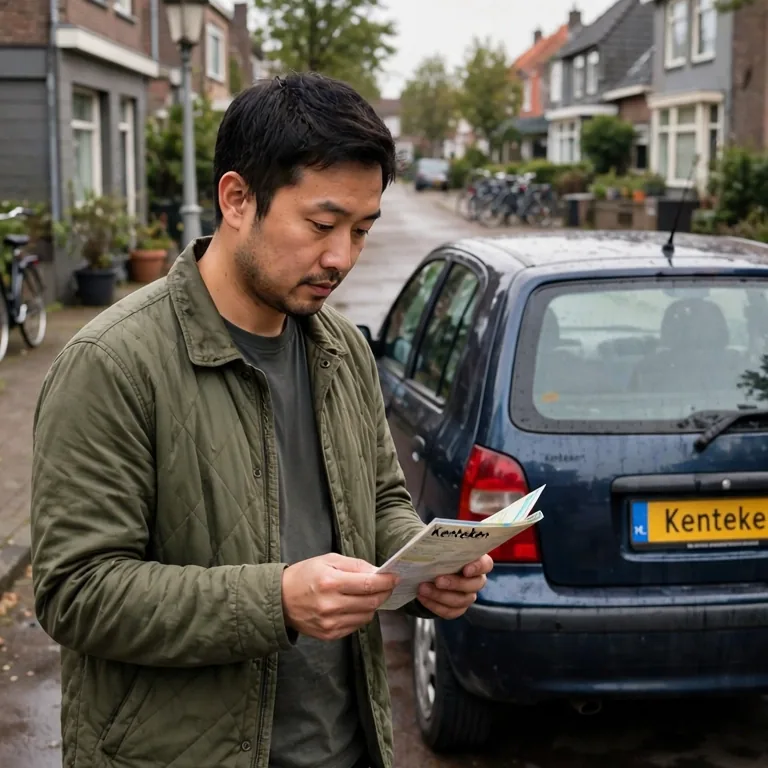
What do you have to arrange for a car you own in the Netherlands?
As soon as RDW (the Dutch vehicle authority) puts a car in your name, you must have WA (third-party liability) insurance in force. Unless you are exempt, you also have to pay motorrijtuigenbelasting (MRB, motor-vehicle tax). When an APK (periodic vehicle inspection) is due, it must remain valid. In 2026 a Dutch registration transfer costs €13.10. Before you drive, check your licence and whether any foreign-plate exemption applies.
The rules for registering a vehicle, for your licence being valid, and for being allowed to use foreign plates are not the same. Before paying, verify all three.
Can you drive using your licence and the car's number plates?
Look at your licence and the car's registration as two separate matters. If you are a Netherlands resident and the car carries foreign plates, either import it or make sure an exemption applies before you drive.
Wide tables can be moved sideways when you scroll.
| Your situation | What to check |
|---|---|
| Dutch-registered car | Inspect it, arrange insurance and complete the RDW transfer. |
| You live in the Netherlands and the car has foreign plates | Import it or confirm an exemption before driving. Residents have no general six-month grace period. |
| Valid EU (European Union) or EFTA (European Free Trade Association) licence | For cars, the usual limit is 15 years from issue, within the licence’s validity. If your licence was issued more than 15 years ago, you may use it for two years after your move. The licence must have remained valid throughout. |
| Valid licence from outside the EU or EFTA | The usual limit is 185 days after moving. Exchange it if you qualify. Otherwise, pass the Dutch theory and practical tests. An exchange application does not extend the 185-day driving period. |
If you hold an EU or EFTA licence that was issued after you were already registered in the Netherlands, you have to exchange it. Do this before you drive in this country.
People with Ukrainian licences who fall under temporary protection may keep driving. This also applies if the licence has expired.
Consult the RDW foreign-licence rules, and for your specific route use the foreign-licence exchange guide.
In general, you cannot drive a car with foreign plates on Dutch public roads if you are registered in the BRP (population register), or if you ought to be registered there. If no exemption applies, that road use means you owe BPM (vehicle purchase tax) and MRB. NederlandWereldwijd (Netherlands Worldwide) sets out the foreign-plate procedure for your circumstances.
Non-residents can usually use the general tax exemption for no more than three months per year. When your main home is in another EU country and the car is not used to carry goods or people for payment, the maximum is six months per year. The year begins on the first occasion the car is used on Dutch roads. The periods do not have to run one after another. The Belastingdienst (Dutch tax authority) also provides exceptions for study and commuting.
A resident who borrows, rents or leases a car with foreign plates may be allowed to use it for up to two weeks in a row. The car must have been made available outside the Netherlands. Ask for the short-use exemption before you use the car here. For the same car, this option is available only once in any 12-month period. If you go over the limit or do not meet the conditions, BPM and MRB apply from day one.
What do you need to verify before a purchase?
Before you pay for a used car, complete all six of these checks:
- Type the number plate into the RDW plate check. It gives public details about the car's technical data, tax, how many owners it has had and the most recent transfer. The owner's identity is not shown.
- Read the RDW mileage judgement. A “Logical” result means the recorded odometer readings go up. A “No judgement” result may appear for an imported or modified car. It means RDW does not have enough information to assess the mileage. It is not proof that the history is clean.
- Compare the VIN (vehicle identification number) shown on the car with the VIN on the paperwork. Also check when the APK expires, the maintenance records, recalls, damage and any finance or lease claim.
- If the price or the risk makes it worth the expense, have an independent mechanic inspect the car. Get any promised repairs and included items recorded in writing.
- Make sure the seller has the kentekencard (registration card) and the full nine-digit tenaamstellingscode (registration code). If the car has an older paper certificate, confirm that the original registration and transfer documents are all present.
- Calculate the complete monthly cost: insurance, MRB, maintenance, tyres, fuel or charging, and a parking permit. Also check parking zone restrictions. Use the public transport guide to compare your choices.
If you buy from a business, the car must be in line with what you may reasonably expect given its age, price and description. ACM ConsuWijzer (government consumer advice service) explains wettelijke garantie (statutory guarantee). There is no set standard duration.
When an unexpected defect shows up within one year after delivery, the law usually assumes that the car did not comply with the sales agreement at the time of delivery. The seller has to prove the opposite, including if the seller claims you caused the problem. This rule does not apply when the kind of car or the nature of the fault makes that assumption impossible.
Buying from a private seller gives you fewer consumer protections. Use a written contract and have the car inspected.
How is a Dutch registration transferred?
You have to be at least 18 to put a car in your own name. You also need to be registered in the BRP and have a Dutch residential or correspondence address. In 2026 the transfer fee is €13.10.
You must have either a valid kentekencard or a temporary document number, plus the complete registration code. If there is a paper registration certificate, bring the original registration and transfer documents. A paper certificate cannot be transferred online.
Pick one of the two transfer methods below. The route open to you depends on your identity document and on which type of registration document you have.
Wide tables may be scrolled from side to side.
| Route | What you need |
|---|---|
| Online | Your DigiD (digital government login) app with an identity check, plus the vehicle documents. The DigiD setup guide explains the app. |
| In person | Since January 2026, a kentekenloket (vehicle registration counter) or approved company requires a valid Dutch driving licence. With a passport, accepted identity card or EU or EFTA licence, use an RDW desk or inspection station. |
You cannot use a residence permit or a foreign-national identity document to register a car. See the RDW list of accepted identity documents for your document. If your identity document does not display your BSN (citizen service number), have that number ready to give to the desk employee.
Once you have checked the car and the documents, carry out the handover in the following order:
- Set up WA insurance so it begins when the transfer takes place.
- Carry out the transfer using the route you selected.
- Keep your tenaamstellingsverslag (registration report) and part 1 of the code.
- Hand the seller the vrijwaringsbewijs (proof that the car is no longer in their name).
- Only collect the car once the seller has that proof.
The transfer is effective straight away. Any earlier suspension comes to an end, and the insurance, tax and any APK obligations now fall to you. The kentekencard and part 2 of the code are sent by post. For up to 14 days, you are allowed to drive in the Netherlands without the card. When driving abroad, you must carry it. To confirm the car is in your name, use Mijn RDW (your vehicle account), not the public number-plate check.
Which insurance, tax and inspections are required?
Once the car is registered in your name, look at the three obligations involved. Exemptions may be available for MRB and APK. If you formally suspend the registration, those obligations are paused as long as the car stays off public roads.
Wide tables can be scrolled horizontally.
| Duty | What you must arrange |
|---|---|
| WA insurance | Arrange the policy yourself before transfer. Cover must start at registration. WA covers damage you cause to others. |
| MRB | Unless exempt, you owe tax from registration, even if the car stays on private land. The Belastingdienst sends the bill automatically. |
| APK | Keep a valid inspection when one is due. Check the expiry date and book the test yourself. |
Provide your licence plate and the meldcode (insurance registration code) to the insurer. The meldcode is the last four digits of the VIN. Ask for written confirmation of the insurance start time. Casco, which covers damage to your own car, is optional; WA does not cover that damage. Check with the insurer whether it accepts your foreign licence and no-claims record.
Household personal liability insurance is separate from car insurance. To arrange household cover, go to the personal liability and contents insurance guide.
MRB is determined by vehicle type, weight, fuel, emissions and province. Use the calculation tool on the MRB page. If you owe MRB and no bill arrives within one month after registration, contact the Belastingdienst. The tax is still owed.
A passenger car qualifies for the oldtimer (classic car) MRB exemption if it meets both age conditions. Its first use must have been at least 40 years ago and before 1 January 1988. The exemption is automatic. Insurance and any required APK still apply.
For 2026, a passenger car that is fully electric or runs on hydrogen owes 70% of the matching full petrol rate, unless it is exempt. A passenger car with CO₂ emissions of 1–50 grams per kilometre pays the full rate, unless it is exempt. Look at 2026 electric-vehicle rates before you budget.
Example: when the matching full petrol rate is €100 per quarter, a fully electric passenger car pays €70 per quarter in 2026. That €100 is only an example amount. For your car’s actual rate, use the tax calculator.
For ordinary passenger cars that weigh up to 3,500 kg and are under 30 years old, the APK schedule depends on the fuel. Petrol and electric cars get their first test after four years, then at six years and eight years, and after that every year. Diesel and LPG (liquefied petroleum gas) cars get their first test after three years, and after that every year.
A car that is 30–49 years old needs an APK every two years. A car that is 50 years old or more has no APK duty. The age is counted from the date the car was first admitted to the road.
Testing up to two months early keeps the existing expiry day and month. Confirm the exact deadline in the RDW APK schedule or Mijn RDW.
How do you suspend a car you are not using?
A schorsing (registration suspension) may last one, two or three years. While it is in effect, MRB, WA and APK duties stop. You must keep the car off public roads, including when it is parked. Apply through RDW suspension service.
While the car is suspended, you may drive to a booked inspection, but only under specific conditions. If you have an APK appointment, take out insurance for the car for that day and carry the appointment confirmation. Drive the shortest route around the appointment time. Obtain an APK report dated that day, regardless of whether the car passes or fails.
When you transfer the registration, the suspension stops. Your obligations come back either when the suspension period runs out or when you choose to stop it. Should you stop it within 30 days, MRB payment is required for the time the suspension covered.
What if you receive an insurance or inspection fine?
Paying a fine does not remove your duty to have insurance and inspection. You can fix the missing coverage or inspection, or you can suspend the car and keep it off public roads. For 2026, RDW fine table shows a €500 amount for an uninsured passenger car and €190 for a vehicle up to 3,500 kg that lacks a valid APK. Every day, RDW checks the registration, insurance and APK records against each other.
Correcting the car's situation will not by itself cancel a fine you received earlier. Use the appeal steps and the deadline shown on the notice. When the car had insurance on the check date, request the official statement from your insurer that an appeal requires. When the car had a valid APK, submit the inspection report as proof. The Openbaar Ministerie (public prosecution service) describes these evidence rules.
How do you bring a car from abroad?
Check first if an exemption covers you before you drive with foreign plates. If no exemption applies, Dutch residents owe BPM and MRB starting on the first day the car is used on Dutch public roads. Where the car originated determines the registration process and the Douane (Customs) rules.
If you bring your own car when you move, follow the RDW moving-import route. If you buy a car in another EU or EFTA country, use the RDW European-import route.
When you buy a car outside the EU, you must finish the Douane declaration at the place where you bring it into the Netherlands. Purchases made in EFTA countries follow the same rule. Look at Douane car-import rules before the RDW inspection.
For a move from another EU country, the BPM moving exemption covers BPM only. All these conditions apply:
- The car is part of your household goods.
- You will use it for the same purpose after moving.
- You owned and used it for at least six months before the move.
- Your normal residence was abroad for at least 12 months before the move.
- You apply within 12 months after moving.
Submit your exemption request before the RDW inspection, and take the required exemption document with you. Family members living in your home are allowed to drive the car. Should you sell, rent or lend it during the 12 months after the exemption begins, BPM becomes payable. An exemption from BPM does not cancel registration or any MRB obligation.
For a move from outside the EU, use the Douane relocation route. Complete the required declaration before the RDW inspection.
Ahead of the RDW inspection, finish any declaration that Douane requires and get any exemption documents your route needs. Then register the car in the order below:
- Book the RDW inspection.
- Take the original foreign registration certificate and the documents required for your route to the appointment.
- File the required BPM return, even if an approved moving exemption makes the amount zero. An exempt moving vehicle needs a paper return.
- After RDW and Belastingdienst approval, use the registration certificate to get Dutch plates.
Arrange WA insurance to start when the car is registered in your name. Registration also starts MRB unless an exemption applies.
If your car comes from the EU or EFTA, ask RDW to accept any valid inspection from those countries and bring proof to the appointment. When an APK is required and no inspection is accepted or carried out, arrange the test immediately after you receive the Dutch registration certificate. For a relocation from outside the EU or EFTA, RDW issues an APK report after approval.
What are the parking and zone rules?
Before you buy, check paid parking, resident permits, visitor schemes and waiting lists for your address. These rules are set by your gemeente (municipality). A car does not guarantee a permit. For instance, Amsterdam’s resident-permit page checks address eligibility, costs and waiting lists. Other municipalities set their own conditions.
A blauwe zone is a parking-disc zone. There, you need a parkeerschijf that satisfies Dutch rules. Put it where it can be seen behind the windscreen, and set it to the time you arrived. You are allowed to round up to the next full hour or half hour. The sign shows the longest time you may park; obey it. The Rijksoverheid (Dutch government) sets out the rules for the parking disc.
If you do not pay municipal parking charges, you may receive a naheffingsaanslag parkeerbelasting (parking-tax assessment). A traffic offence may result in a fine from the CJIB (Central Judicial Collection Agency). Do what the issuer tells you and meet the deadline shown on the notice. The Rechtspraak (Dutch judiciary) explains both procedures.
A milieuzone (environmental zone) may ban older diesel passenger cars based on their emissions class. Petrol passenger cars are allowed to enter. Before you buy a car or travel, check your plate with the Milieuzonecheck (environmental-zone checker) and check the local boundaries. This checker covers environmental zones only; for zero-emission zones, you must check separately.
Whether a zero-emission zone applies depends on how the vehicle is registered. These zones cover vans and lorries, even when used privately. Vehicles registered as passenger cars are not covered by these rules. If you have a van or lorry, check current access and transition rules through Op weg naar ZES (zero-emission-zone information service). If your use is private only, find out whether you are eligible for an RDW exemption.
What steps should you take after a collision?
Make people safe first, and then document what occurred. Do these steps in the order shown:
- Phone 112 if someone is injured, there is immediate danger, or a blocked road is unsafe.
- Get yourself and other people to a safe place. Only move an injured person if safety makes it necessary.
- Provide first aid if you are able to.
- If it is safe, photograph the positions of the vehicles before you move them.
- If the cars can still be driven, move them somewhere safe.
- Before anyone leaves, swap names, contact information, registration numbers and insurance details.
- Take photos of the damage, the signs and the road conditions.
- Write down the contact details of any witnesses.
- Fill in the Europees schadeformulier (European accident statement), or use the mobile report linked in the police guidance.
When you use the paper form, Politie (Dutch police) recommends telling your insurer within 24 hours. The mobile report sends the information on its own.
Police do not come to every collision that involves only damage. They do attend when there are injuries, very serious damage, suspected drink-driving, no licence or insurance, aggression, a road that cannot be cleared, or a dispute the parties cannot settle. Insurers determine who must pay for the damage. If the situation is unsafe, call.
How can you sell or export a car?
If you sell the car in the Netherlands, keep both the car and its keys until the buyer finishes the transfer and you get the vrijwaringsbewijs. If the car has been inspected, give the buyer the most recent APK report. In Mijn RDW, check that the car is no longer in your name, then cancel or change your insurance. The RDW notifies the Belastingdienst.
Keep the proof. If you lose it, download an RDW overview of vehicles that were previously registered in your name. Many insurers accept this overview. The RDW lost-proof guidance explains how to obtain it.
When the buyer lives outside the Netherlands, the car must be formally exported. Let the buyer register the export in their own name. If you arrange the export, you stay responsible until the car is registered abroad. Follow the RDW export procedure. Keep the vrijwaringsbewijs and the export documents, and do not cancel your insurance until the deregistration is confirmed.
After export, you can drive in the Netherlands for a maximum of 14 days using the white export plates. For those trips, the car must be insured and have a valid APK.
What do you need to arrange at each stage?
Before you buy or use the car, check your licence, residence status, the plates, the vehicle history, the parking permit, the zones and your monthly budget. Before the transfer, get an insurance quote and confirm when the cover starts. Make sure both parties can receive and save the RDW proof. After the transfer, save the deadlines for insurance, MRB, APK and parking. When you sell or export the car, keep proof that it is no longer in your name.
Use the guide that fits the task you still have to finish:
Official Sources
- RDW: transfer a registration - Buyer eligibility, online and in-person identity routes, fee, immediate effect and transfer documents.
- RDW: sell a vehicle - Seller handover, indemnification proof, APK report and post-sale checks.
- RDW: public plate check - Public vehicle data and the limits of the plate check.
- RDW: check mileage - Mileage judgements and reasons a vehicle can have no judgement.
- ACM ConsuWijzer: guarantee - The statutory conformity right for purchases from a business and the first-year burden of proof.
- RDW: driving with a foreign licence - EU/EFTA, non-EU/EFTA and special foreign-licence time limits.
- NetherlandsWorldwide: foreign plates - Resident and non-resident rules for driving a foreign-plated vehicle.
- Belastingdienst: foreign registration - BPM and MRB duties for Dutch residents using foreign plates.
- Belastingdienst: short-use exemption - The maximum two-week exemption and request conditions.
- RDW: moving with a vehicle - EU/EFTA inspection steps, Customs route and registration after moving.
- Belastingdienst: when BPM is due - BPM events for imports and use of a foreign-registered vehicle.
- Belastingdienst: BPM moving exemption - Residence, prior use, application and 12-month disposal conditions.
- Belastingdienst: MRB - Tax liability from registration, calculation factors and billing.
- Belastingdienst: electric and hybrid MRB - The 2026 rates for electric, hydrogen and low-emission passenger cars.
- Rijksoverheid: compulsory WA insurance - The statutory third-party insurance duty and suspension exception.
- RDW: APK frequency - Inspection intervals and the two-month early-inspection rule.
- RDW: suspend a registration - Duration, duties that stop, road-use ban and limited inspection journeys.
- RDW: insurance and APK fines - The 2026 fines for an uninsured passenger car and a light vehicle without a valid APK.
- RDW: insurance and APK controls - Daily register comparisons and enforcement.
- Rijksoverheid: municipal taxes - Municipal power to charge parking tax.
- Rijksoverheid: blue-zone parking - Parking-disc use, arrival time and signed time limits.
- Rijksoverheid: environmental driving rules - Diesel environmental zones and vehicle categories for zero-emission zones.
- Milieuzones.nl: national zone checker - Diesel environmental-zone access and links to local zone information; this check excludes zero-emission zones.
- Politie: what to do after a collision - Safety, information exchange, evidence and accident reporting.
- Politie: attendance at collisions - Situations where police may attend and the insurer's role in liability.
- RDW: export a vehicle - Export registration, responsibility, proof and the 14-day export-number rule.
- RDW: accepted identity documents - Accepted IDs at registration counters and RDW locations, residence-document exclusions and BSN requirements.
- RDW: registration counters from January 2026 - The January 2026 change requiring a Dutch driving licence at registration counters and approved companies.
- RDW: checks before buying a used car - Vehicle and document checks, VIN comparison, maintenance records and the nine-digit registration code.
- ACM ConsuWijzer: proof when a product breaks - The seller’s burden of proof during the first year, including alleged buyer fault.
- ACM ConsuWijzer: information about the seller - The distinction between buying from a business and a private seller for consumer rights.
- Belastingdienst: foreign-plate exemptions for non-residents - The general three-month limit, the six-month limit for use that excludes paid carriage of goods or people by residents of another EU country, and study and commuting exceptions.
- Business.gov.nl: vehicle insurance - Immediate WA cover, cover for damage to others and optional cover for the car itself.
- Openbaar Ministerie: insurance and inspection fines - Continuing duties after a fine, appeal evidence and why later insurance does not prevent a fine for an earlier uninsured period.
- Douane: bringing a car from outside the EU - Customs declarations at the place of entry for cars purchased outside the EU and the separate relocation-exemption route.
- Amsterdam: resident parking permits - A local example of address eligibility, vehicle requirements, permit costs and waiting lists.
- Rechtspraak: parking-tax assessments and traffic fines - The difference between municipal parking-tax assessments and CJIB traffic fines.
- Op weg naar ZES: zero-emission zones - Separate access rules for vans and lorries, including privately used vehicles.
- RDW: zero-emission exemption for private use - Passenger-car exclusion and the conditional exemption for vans and lorries used only privately.
- RDW: lost indemnification proof - The vehicle-history overview accepted by many insurers when proof is lost.
- RDW: export rules in Dutch - Buyer responsibility, export documents and insured driving on export plates for 14 days.
- RDW: view vehicles in your name - Viewing registration and vehicle status through Mijn RDW.
- Douane: relocation exemptions - The Customs relocation route for household goods and vehicles from outside the EU.
- RDW: insurance registration code - The meldcode used by insurers and its last-four-VIN-digits definition.
- RDW: importing a car purchased in Europe - The separate EU/EFTA purchase route and acceptance of a valid foreign inspection.
- RDW: European import rules in Dutch - Registration, original documents and APK requirements for an ordinary European import.
- RDW: relocation rules in Dutch - Relocation documents, paper BPM returns and the APK report for a move from outside the EU or EFTA.
- RDW: foreign-licence rules in Dutch - Licence validity, residence-related exchange requirements and the temporary-protection exception for Ukraine.
- Belastingdienst: classic-car MRB exemption - Age conditions and automatic MRB exemption for qualifying passenger cars.
- Wijzer in geldzaken (government money advice): insurance types - Compulsory vehicle liability cover and separate household personal liability and contents cover.
- Openbaar Ministerie: Feitenboekje (offence handbook) 2026 - Parking-disc requirements, visible windscreen placement and rounding the arrival time to the next whole or half hour.
- DigiD: official website - Official DigiD website and its login methods, including the DigiD app.
- Overheid.nl (government information portal): first-year defect presumption - Article 7:18a(2): the one-year period from delivery, presumed non-conformity at delivery and statutory exceptions.